How to Increase Organic Traffic
Discover how to increase organic traffic with our guide on SEO, content, and link building. Learn practical strategies for sustainable website growth.

Before thinking about keywords or links, you need a solid foundation. This is what technical SEO is all about. It means making sure your website is fast, secure, and mobile-friendly. This helps search engines like Google find, understand, and trust your content.
Think of it this way: a messy, confusing store turns customers away at the door. Your website is no different.
Build a Foundation Search Engines Trust
Before you publish any content, your website needs to work perfectly for visitors and for search engine bots that "crawl" it. A slow or buggy site is a dead end. It frustrates people and makes it hard for Google to index your pages, which hurts your chances of ranking.
You don't need to be a developer. You just need to understand the main health signals that Google cares about. When your site is technically sound, every other SEO effort you make is more likely to succeed.
Prioritize Your Site's Core Health Signals
Think of technical SEO as basic maintenance for your website. Just like a car needs a good engine, your site needs a healthy technical base to compete in search results. Three areas are essential.
Here’s where to start:
- Site Speed (Core Web Vitals): This is how fast your page loads and becomes usable. If your site is slow, people will leave before they even see your content. Google uses Core Web Vitals to measure this user experience.
- Mobile-Friendliness: Most people use their phones to browse the web. Google uses the mobile version of your site for ranking (this is called mobile-first indexing). If your site is hard to use on a phone, your rankings will suffer.
- Security (HTTPS): The little lock icon in the browser is important. An SSL certificate (which gives you "https" in your URL) protects user data and is a basic sign of trust for both users and search engines.
Ignoring these is like building a house on sand. No matter how great the inside looks, it will eventually fall apart.
Make Your Website Easy to Crawl and Index
For Google to rank your pages, it first has to find them. This process is called crawling and indexing. You can make Google’s job much easier.
An XML sitemap is a map of your website that you give to search engines. Submitting it through Google Search Console is like telling Google, "Here are all the important pages on my site. Please take a look."
A clean internal linking structure also helps a lot. It allows search engine crawlers to move from one page to another, showing them how your content is connected. This simple step helps spread authority across your site and gets new content discovered faster. Layer in high-value hubs: how to check backlinks in Google, best backlink analysis tools, keyword research best practices, how to find broken links on a website, profile backlinks, YouTube CTR and AVD, best link-building tools, SaaS SEO strategy, and SEO software comparison—plus best on-page SEO tools for snippet-ready pages.
A healthy technical foundation isn't a one-time task. It's an ongoing commitment. I regularly check my clients' sites for speed, mobile issues, and crawl errors to ensure technical problems aren't hurting our progress.
The numbers back this up. Organic search is a huge traffic driver, expected to account for 53% of all website traffic by 2025. With mobile devices also making up about 53% of eCommerce visits, a fast, mobile-friendly experience is crucial.
For anyone working in the software world, these technical details are even more important. If you're tackling these kinds of challenges, connecting with others in the same boat can be a huge help. The SaaS SEO Community on Reddit is a great spot for that.
Create Content Your Audience is Actually Searching For
A perfect website is like an empty stage. To draw a crowd and grow your organic traffic, you need a great performance. That performance is your content.
But great content isn't just about good writing. It's about knowing exactly what your audience needs and giving them the best possible solution.
This is where startups and small businesses can win. You don't need a massive budget; you just need to be smarter and more helpful than your competitors. That means going beyond basic keywords and understanding the real reason behind every Google search: search intent.
Go Beyond Keywords to Understand Search Intent
Keywords tell you what people are typing into Google. Search intent tells you why.
For example, someone searching for "best project management tool" is in a different mindset than someone searching for "how to create a Gantt chart." The first person is ready to compare products and buy. The second just wants to learn.
Understanding this difference is key. When your content perfectly matches what the user wants to do, Google sees your page as the best answer and rewards you with higher rankings.
Search intent usually falls into one of four types:
- Informational: The user wants to learn something (e.g., "what is SEO?").
- Navigational: The user wants to find a specific website (e.g., "Facebook login").
- Commercial: The user is researching before making a purchase (e.g., "Ahrefs vs Semrush").
- Transactional: The user is ready to buy or take action (e.g., "buy running shoes").
If you want to go deeper on this, see our guide on search intent optimization.
The infographic below shows how important site health is. Even the best content will fail if your site is slow, buggy, or hard to use.
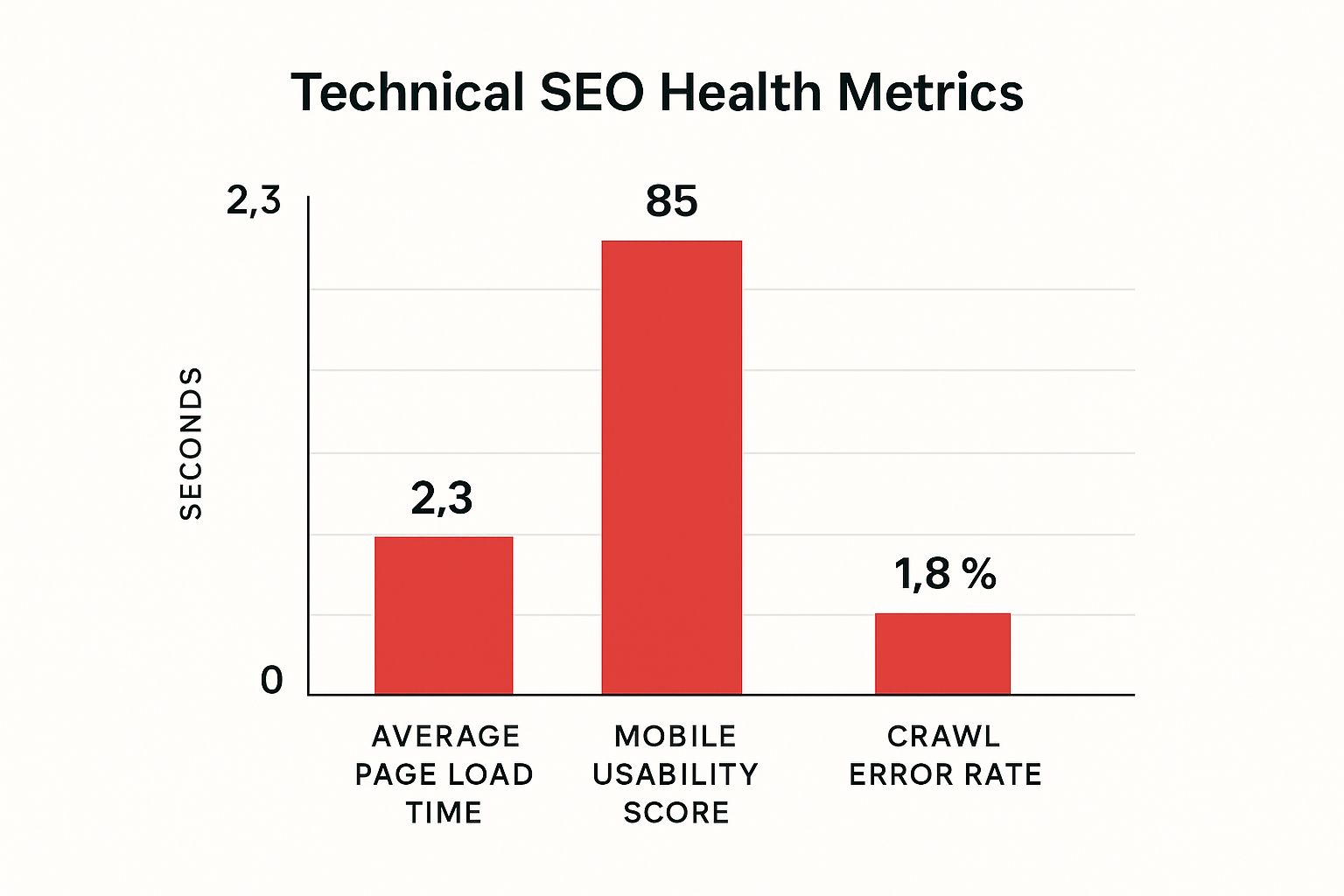
As you can see, factors like page speed and mobile-friendliness directly affect how well your site is crawled, which sets the stage for your content to succeed.
Matching Content to Search Intent
Match your content type with what a user wants to achieve. This makes your content more relevant and helps it rank higher.
| Search Intent | What the User Wants | Best Content Format |
|---|---|---|
| Informational | To learn something or find an answer. | Blog posts, how-to guides, infographics, videos. |
| Commercial | To research and compare products or services. | Comparison articles, reviews, case studies, product lists. |
| Transactional | To make a purchase or take a specific action. | Product pages, pricing pages, sign-up forms, demos. |
| Navigational | To find a specific website or page. | Homepage, about page, contact page, login screen. |
By creating content in these formats, you're not just guessing what users want—you're giving them exactly what they came for.
Build Authority with Topic Clusters
Stop writing random blog posts. Instead, think like a librarian. A library has an entire section on a subject, not just one book. This makes it an authority. A topic cluster does the same for your website.
Here's how it works: You create a long, detailed "pillar" page on a broad topic, like "content marketing." Then, you write several shorter "cluster" articles on specific subtopics, like "writing blog posts" or "email marketing." Finally, you link all the cluster pages back to the main pillar page.
This structure is powerful for two reasons:
- It guides visitors to related content, keeping them on your site longer and showing them you're an expert.
- It signals to Google that you have deep authority on the topic, which helps all the related pages rank higher.
My personal tip for founders: Don't try to cover everything at once. Instead of a huge pillar on "digital marketing," start with something specific like "SEO for early-stage SaaS startups." Own that niche first, then expand.
To make sure every piece you create gets results, it's important to follow proven content marketing best practices.
Focus on High-Value Niche Content
As a smaller business, you won't beat big companies for broad, competitive keywords. That's okay. Your advantage is being specific.
Your goal is to create the single best resource online for a very specific problem your ideal customer has.
For example, if you sell handmade camera straps, don't just target "camera accessories." Instead, create a guide on "The Best Camera Straps for Landscape Photographers Who Hike." This topic is focused, attracts the right audience, and has less competition.
Data shows this works. The #1 organic result on Google gets an average click-through rate of 27.6%. And what kind of content gets to the top? Detailed content. The average word count for a first-page result is 1,447 words.
By creating in-depth, niche content that matches search intent, you can win the top rankings for the keywords that actually grow your business.
Perfect Your On-Page SEO Signals
You've created great content that matches what people are looking for. Now what? You need to make sure Google understands it. This is what on-page SEO is all about—sending clear signals to search engines about what your page is about and why it's the best result.
Think of it like organizing a document. A wall of text is hard to read. But if you add a title, clear headings, and bullet points, it becomes much easier to understand. On-page SEO does the same for search engines and your readers.
This isn't about stuffing keywords everywhere. It's about structure, clarity, and making your content easy for both humans and bots to understand. Get this right, and you'll have happy readers and happy search engines. That’s how you increase organic traffic.
Craft Compelling Title Tags and Meta Descriptions
Your title tag and meta description are your first impression in the search results. They are often the only thing a person sees before deciding whether to click on your link.
The title tag is the clickable blue headline in Google. It's a very important on-page factor. Keep it short (around 60 characters), include your main keyword, and give people a good reason to click.
The meta description is the small text snippet under the title. It's not a direct ranking factor, but a good description can greatly improve your click-through rate (CTR). It should accurately describe what's on the page and encourage the user to click.
A great title makes a promise. A great meta description explains how the content delivers on that promise. Never underestimate this combination for winning the click.
If you want to learn more, our guide on best on-page SEO tools explains how to craft titles and snippets that earn clicks.
Structure Content for Readability and Rankings
A well-structured article is like a roadmap for search engines. Use heading tags (H1, H2, H3) to organize your content.
Think of them as an outline for your page:
- H1 Tag: This is your page's main headline. You should only have one H1 per page. It should clearly state the topic.
- H2 Tags: Use these for the main sections of your article. Think of them as chapters. They're a great place to include related keywords.
- H3 Tags: Use these for sub-points within your H2 sections. They help you add more detail and organization.
This structure makes your content easy to scan for users. It also helps Google understand the relationships between different ideas on your page, which strengthens its understanding of your topic.
Optimize Images for Speed and Context
Images make your content more engaging, but they can slow down your page if they are too large. I've seen many slow websites where the problem was large, uncompressed image files.
Before uploading an image, do these three things:
- Compress it: Use a tool to reduce the file size without losing much quality. This can dramatically speed up your load time.
- Use descriptive file names: Instead of
IMG_1234.jpg, rename it to something likeon-page-seo-signals.jpg. This gives Google a small clue about the image. - Add alt text: Alt text describes the image for screen readers and search engines. It's another good place to add relevant keywords.
Use Internal Links to Guide Users and Bots
Internal links—links that point from one page on your site to another—are a very useful SEO tool.
They help users discover more of your content, keeping them on your site longer. This improves engagement, which search engines notice.
Internal links are also vital for search bots. They help crawlers find all your pages and understand how they are related. When you link from a high-authority page to a new one, you pass some of that "link juice," helping the new page get indexed and ranked faster. The goal is to build a strong network of content that shows you're an authority on your topic.
Earn Authority with Strategic Link Building
Think of the internet as a popularity contest where votes actually matter. In SEO, backlinks are those votes. When another credible website links to your content, it sends a powerful signal to Google that your page is trustworthy and valuable.
Many people make the mistake of trying to get any link they can. This is a bad approach.
Quality is much more important than quantity. One good link from a respected site in your industry is worth more than a hundred links from spammy, irrelevant websites. Your goal isn't just to get links; it's to build a natural backlink profile that proves you're a real expert in your field.
This is the key to turning great content into content that ranks and drives traffic.
Create Assets People Want to Link To
The best link-building strategy is simple: create something so useful that other people want to link to it. These are called "linkable assets."
Instead of sending countless emails asking for links, you build a resource that earns them naturally.
Here are a few types of linkable assets that work well:
- Original Data and Research: Conduct a survey in your industry and publish the findings. Journalists and bloggers love new stats and will link to you as the source.
- Free Tools or Calculators: If you're a software company, build a simple, free tool that solves a small problem for your ideal customer. Think mortgage calculators for real estate sites or headline analyzers for marketing blogs. These are link magnets.
- The Ultimate Guide: Choose a topic your audience cares about and create the most comprehensive and helpful guide on the internet about it. If your resource is truly the best, it will naturally become the go-to reference for others.
This approach changes the game. You stop being just a content creator and become a valuable resource provider. That shift helps you earn the high-quality links that make a real difference.
Master the Art of Guest Posting
Guest posting is an old SEO tactic that still works well when done right. The idea is simple: you write an article for another website in your niche, and in return, you get a link back to your site, usually in your author bio.
The key is to be strategic. Don't just send generic pitches to every blog you find. Relevance and quality are everything.
A good guest post does more than just build a link. It puts your brand in front of a new audience, establishes you as an expert, and can drive high-quality referral traffic for years.
Before I pitch a site, I ask myself:
- Is their audience my audience? A link is almost useless if the people who click it aren't interested in what I offer.
- Does this site have real authority? I look for sites with a good Domain Rating (DR) using a tool like Ahrefs and a history of publishing quality content.
- Can I get a contextual link? A link placed naturally within the article is more valuable than one in the author bio at the bottom of the page.
By being selective and providing real value, you can build powerful links that improve your rankings.
Turn Broken Links into Opportunities
Broken link building is a smart and effective tactic. It’s a win-win situation. You help a website owner fix a problem (a dead link), and you get a relevant backlink in return.
The process is simple:
- Find relevant websites in your industry with resource pages or articles that have many outbound links.
- Use a tool like Ahrefs' Site Explorer or a browser extension to find broken links on their pages (links that lead to a 404 error).
- Reach out to the site owner. Be friendly and helpful, and let them know you found a dead link on their page.
- Subtly suggest your own content as a replacement. If you have a blog post that fits perfectly, it's a natural and helpful suggestion.
This method works because you start by offering value. You're not just asking for something; you're helping them improve their website. It’s a great way to build relationships and earn high-quality links.
Let's be honest: SEO is always changing.
What worked a few years ago might not work today. Instead of chasing every algorithm update, focus on building a strategy that's ready for the future. It's about playing the long game.
https://www.youtube.com/embed/_s2h7X-c2jE
This means moving away from short-term tricks and focusing on building a brand that people trust and look for. When your audience starts searching for your brand name directly, you're less affected by changes in search engine rankings.
The goal is simple: create content so good that your audience would miss it if it were gone.
Get Hyper-Specific to Win
People are using longer, more conversational search queries. Instead of typing "running shoes," they might ask, "best waterproof trail running shoes for narrow feet."
This is the world of long-tail keywords, and it's a huge opportunity for smaller businesses.
These longer phrases have lower search volume, but the intent behind them is very high. The person searching knows exactly what they need. If you can provide the perfect answer, you've gained a highly qualified visitor who is more likely to become a customer.
By 2025, long-tail keywords are expected to make up 69% of all search queries. But a new challenge is emerging. Some predict that by 2028, organic search traffic could drop by as much as 50% because of AI-powered answers that satisfy users without a click.
To prepare, you need to focus on creating deep, experience-based content that AI can't easily replicate. For a deeper look at this shift, check out the analysis at TheeDigital.com.
Prepare for Search Beyond the Text Box
The classic search bar isn't the only way people search anymore. Voice and visual search are growing fast. Adjusting your content for these formats is a smart way to protect your future traffic.
Here’s how to start optimizing for them:
- Voice Search: People speak differently than they type. Voice searches are often full questions. Structure parts of your content in a Q&A format. Use natural, conversational language.
- Visual Search: High-quality, original images are essential. Make sure your product photos are clear and that your images have descriptive alt text. This helps tools like Google Lens understand your pictures and show them in visual search results.
These are small, smart adjustments to meet people where they are, no matter how they’re searching.
Thriving in an AI-Powered Search World
With AI summaries appearing directly in search results, getting that click is harder than ever. The game is changing.
So, how do you stand out when Google tries to answer the question for you?
You focus on the one thing AI can't fake: genuine, first-hand experience.
In the age of AI, the most powerful content will be built on real expertise and unique perspectives. This means case studies with actual data, product reviews where you've truly used the product, and personal stories that create a human connection.
An AI can repeat facts it finds online, but it can't create new, authentic experiences. By positioning yourself as a trusted source with real-world insights, you give people a reason to click past the AI summary and visit your site for the real story.
This is how you build a brand that not only survives the future of search but thrives in it.
Common Questions About Organic Traffic
As you learn about SEO, you'll likely have questions. It can seem complex, but the core ideas are usually straightforward.
Let's answer some of the most common questions from founders and marketers. Understanding these basics helps you set realistic goals and focus on what truly matters.
How Long Does It Take to See Results From SEO?
The honest answer is: it depends. SEO is a marathon, not a sprint. You might see small improvements from technical fixes in a few weeks, but don't expect a sudden rush of traffic.
For meaningful growth from your content and link-building, you're typically looking at a timeline of 4 to 12 months.
Several factors can affect this timeline:
- Your Industry: Ranking for a competitive term like "project management software" is harder and takes longer than ranking for "artisanal dog collars for poodles."
- Your Website's History: An established site has a head start. A brand-new domain starts from zero.
- Your Consistency: This is key. The more consistently you publish helpful content and earn quality links, the faster you'll see progress.
The secret is to focus on steady improvements over time. Chasing quick wins often leads to frustration. A consistent, disciplined approach builds a reliable source of traffic for the long term.
Is Content or Technical SEO More Important?
That's like asking if a car needs an engine or wheels. You need both to get anywhere. They work together.
Technical SEO is the foundation of your house. It ensures your site is fast, secure, and easy for Google to understand. If the foundation is weak, the whole house will have problems. The best content is useless if search engines can't find it.
Content is the house itself—it's what people come to see. It attracts and helps your audience. It's how you earn rankings, build authority, and turn visitors into customers.
You need both. My advice? Fix your technical foundation first. Once that's solid, you can focus on creating high-quality content consistently.
Can I Do SEO Myself or Do I Need an Expert?
You can definitely get started on your own. For any founder or small business, learning the basics of on-page SEO, content creation, and site health is a great use of your time. Many of the strategies we've discussed are manageable for a small team.
However, there comes a point where an expert can speed things up.
As your business grows, or if you're in a very competitive market, hiring a professional can accelerate your results. They can handle complex tasks like deep technical audits, advanced link-building campaigns, and detailed competitive analysis to give you an edge. It’s all about knowing when to do it yourself and when it’s time to call for help.
Ready to stop guessing and get a clear, actionable plan to grow your organic traffic? SEO Roast provides founder-focused SEO audits and tools that deliver a prioritized roadmap for your product. Get the clarity you need to turn search into a reliable growth channel at https://seoroast.co.