A Startup's Guide to Comparing SEO Software
Our startup SEO software comparison breaks down the best tools. Get a clear, founder-focused analysis of features, use cases, and pricing to choose wisely.

Choosing the right SEO software comes down to one simple question: what's your startup's biggest growth goal right now? For some, that means an all-in-one tool like Ahrefs or Semrush, giving you a huge toolbox for finding keywords and analyzing links. For others, a focused tool is smarter, helping you directly with a specific goal, like creating a lot of content quickly.
Choosing Your Startup's SEO Software
For a startup founder, picking an SEO tool isn't just another expense. It’s a key decision that helps your company grow. The right tool can multiply your efforts, turning your hard work on content into a steady stream of visitors from search engines. The wrong one becomes a costly distraction, wasting money and time on features you'll never use.
This guide is a straightforward seo software comparison to help you figure out what really matters. We’ll cut through the sales hype to focus on the core functions that deliver real results for a new company.
The Four Pillars of SEO Tools
Every good SEO plan is built on four key pillars. The software you choose needs to handle these tasks in a way that makes sense for a lean startup.
- Keyword Research: This is about understanding what your customers are searching for on Google. A good tool helps you find opportunities your competitors have missed.
- Rank Tracking: You can't improve what you don't measure. This feature watches your website's position in search results for your target keywords, showing you what’s working.
- Backlink Analysis: Links from other websites are like votes of confidence. Looking at your own links—and your competitors'—is essential for building authority and ranking higher.
- Technical Audits: A healthy website ranks better. Audits scan for issues like broken links or slow pages that can hurt your performance without you knowing.
To make a smart choice, it's also helpful to look at comparisons of the best ChatGPT rank tracker tools to see how new AI technology is being used for these key jobs.
| Core Function | What It Does for a Startup | Key Question It Answers |
|---|---|---|
| Keyword Research | Finds valuable search terms | What are my customers searching for? |
| Rank Tracking | Measures progress and visibility | Is my SEO strategy working? |
| Backlink Analysis | Checks website authority | Who is linking to me and my competitors? |
| Technical Audit | Finds and fixes site health issues | What is stopping my site from ranking? |
The need for these tools is driving huge industry growth. The global SEO software market was valued at USD 74.6 billion in 2024 and is expected to more than double to USD 154.6 billion by 2030. This shows just how vital this software has become for businesses.
Core Feature Deep Dive: A Side-by-Side Analysis
Let's look past the long feature lists. What really helps a startup founder gain momentum?
I'll break down the practical differences between the big three—Ahrefs, Semrush, and Moz Pro—across the four key areas you'll use daily. The goal isn't to pick a single winner, but to show you how each tool handles the tasks that actually grow your business.
H3: Keyword Research Capabilities
Good keyword research is more than finding popular terms. It's about discovering the less competitive phrases your customers are actually using. Each platform approaches this differently.
Ahrefs is powerful for its raw data and filtering. Its "Keywords Explorer" is great for digging into a massive keyword database with precision. You can quickly find questions, terms with low competition, and phrases that get a lot of clicks. For a startup, this means finding winnable battles early on.
Semrush thinks more like a content planner. Its "Keyword Magic Tool" is excellent at grouping suggestions into topic clusters. Instead of just a long list of keywords, you get a structured map of related ideas. This makes it much easier to plan your content and build authority around a central theme. It's also useful to know how to integrate powerful tools like Semrush to see how these features work in practice.
Moz Pro keeps it simple. Its keyword database isn't as large, but its strength is the "Keyword Priority" score. This single number combines search volume, difficulty, and click-through rate, which is a big help for founders who need quick, clear insights without getting lost in data.
H3: Backlink Analysis Accuracy
A tool's database of backlinks is its heart. The size and freshness of this data directly affect your ability to build a successful link strategy. This is where the platforms really differ.
To be direct: Ahrefs has the best backlink data. Their web crawler is famously second only to Google's. This gives you the most current and complete view of any website's links. For checking on competitors, it’s a game-changer.
Semrush has a very large and capable backlink database, though it's historically been a bit smaller and slower to update than Ahrefs'. Where it truly excels is its "Backlink Audit Tool." This feature is great for finding and removing harmful links—a key task for keeping your site healthy.
Moz Pro was a pioneer with its "Domain Authority" (DA) score, but its backlink database is the smallest of the three. While DA is a useful quick check, relying only on Moz for a deep dive into a competitor's links might mean you miss important information.
To quickly summarize the main strengths of each tool, here's a simple breakdown.
At-a-Glance Feature Comparison
This table helps you see where each tool shines and who it’s best for.
| Tool | Primary Strength | Best For Startups Focused On | Key Limitation |
|---|---|---|---|
| Ahrefs | The most complete backlink database. | Deep competitor analysis and finding link-building opportunities. | Can feel overwhelming; takes longer to learn. |
| Semrush | All-in-one toolkit with strong content marketing features. | Building a full content strategy and managing paid ads alongside SEO. | Backlink data is slightly less fresh than Ahrefs'. |
| Moz Pro | Easy-to-use interface and simple metrics. | Founders needing quick, clear SEO insights without deep technical knowledge. | The smallest backlink and keyword databases. |
Ultimately, your choice depends on whether you value raw data, an all-in-one system, or simplicity.
H3: Site Audit Actionability
A site audit tool should do more than find problems; it needs to help you solve them. This is especially true for founders who are not technical SEO experts. For a closer look, you can also check out our guide on the best on-page SEO tools.
Semrush's "Site Audit" is very founder-friendly. It groups issues into "Errors," "Warnings," and "Notices" and provides simple "why and how to fix it" guides for each one. It turns a scary technical report into a straightforward to-do list.
Ahrefs has a fast and powerful site audit, great for scanning large websites and finding technical issues. The charts are clean and the filters are helpful. However, the explanations can sometimes be a bit technical, assuming you already have some SEO knowledge.
Moz Pro's audit is simple and good at flagging common on-page errors. It works well with its other tools, but it crawls sites much slower than Ahrefs or Semrush. For a large, complex website, this can be a real issue.
H3: Rank Tracking Precision
You need to know if your hard work is paying off. For rank tracking, what's most important is how often it updates, its accuracy, and its ability to track local search results.
Semrush gives you daily updates and has very strong local tracking, letting you monitor keywords for a specific city or ZIP code. Its "Position Tracking" tool also shows you if you appear in special search features (like a featured snippet or image pack), giving you a fuller picture of your online presence.
Ahrefs also offers daily, accurate rank tracking. Its clean interface focuses on key metrics: position, traffic, and search features. Its local tracking is solid, but Semrush provides more detailed control if you are a local business.
Moz Pro is behind here, offering weekly tracking on its standard plans. For a startup in a fast-changing industry, that's often too slow. While the data is reliable, the slower refresh rate makes it less ideal for tracking very competitive keywords.
Understanding The SEO Tooling Landscape
Before you can pick the right SEO software, it helps to understand the world they operate in. It’s not just about what the features are, but why they exist. And that story is all about Google.
Google's dominance is almost unbelievable. It handles around 90.4% of all searches worldwide, making it the only platform that matters for most businesses. This is why nearly every SEO tool is built to work with Google's algorithm. Other search engines like Bing and Yahoo exist, but they are usually a secondary thought unless you're targeting specific international markets.
This focus on Google shapes everything. It’s why you see features like backlink analysis, keyword difficulty scores, and technical audits in every major tool—they’re all designed to help you succeed on Google.
Who Are These Tools Really For?
While tools like Ahrefs and Semrush can seem very complex, they're increasingly designed for businesses like yours. In fact, small and mid-sized businesses make up a huge 65% of the global demand for SEO software.
Even more telling, the rate of startups using these tools has jumped by 42% year-over-year. This shows that founders are treating SEO not just as a marketing task, but as a core part of their growth plan. This is why the tools are becoming easier to use, with cleaner dashboards and clearer advice. They know their biggest customers are not giant corporations, but founders trying to get started.
Key Takeaway: The complexity of SEO tools comes from trying to understand Google's complex algorithm. But the industry's real growth is from founders and small businesses, which is pushing these platforms to be more user-friendly and results-driven.
The Rise of AI in SEO Tooling
The entire landscape is also being changed by artificial intelligence (AI). AI has gone from a buzzword to a core part of these platforms, handling tasks that used to take days of manual work. For example, AI can now plan out entire content strategies, find the best internal linking opportunities, and even predict the traffic you might get from a new keyword.
This changes your role as a founder. You're no longer the one stuck analyzing data; you're the strategist making the final decision. You can see how much this is changing the game in our complete guide to AI-powered SEO tools. When choosing a tool, pay attention to its AI features. A platform with smart automation can give a small team a huge advantage.
Practical Use Cases For Startup Growth
A features list on a pricing page is just potential. To turn that potential into growth, you need a plan. Let’s move beyond a theoretical seo software comparison and look at practical, real-world workflows founders can use to get results.
We'll walk through three common startup situations. For each one, I'll match it with a specific tool and outline a step-by-step plan. The goal is to show you not just what the software does, but exactly how to use it to reach a specific business goal.
The Content-Led SaaS Startup
Imagine you're building a software product in a crowded market. Your main way to grow is through content marketing, and your mission is to become the top authority in your field. For this job, Semrush is a great choice because of its powerful features for discovering topics and spying on your competitors' content.
Here’s a simple workflow to build a content advantage with Semrush:
- Find Core Topics with the Keyword Magic Tool: Open the tool and enter a broad "seed" keyword related to your product—like "project management software." Semrush will return thousands of keywords, but the real value is in the topic clusters it creates on the left side.
- Map Out Your Content Hubs: Those clusters are your future content hubs. A cluster like "agile project management" becomes your main "pillar" page. All the individual keywords inside it, like "agile project management techniques," become the supporting blog posts that link back to that main page.
- Analyze Competitor Gaps: Use the "Keyword Gap" tool and enter your domain against three or four top competitors. This instantly shows you all the keywords they rank for that you don't. Now you have a prioritized list of content to create to start winning their traffic.
- Create Content Briefs with the SEO Writing Assistant: For every keyword you target, run it through the SEO Writing Assistant. The tool analyzes the top-ranking pages and gives your writers clear advice on word count, related keywords to include, and readability.
This approach turns content creation from a guessing game into a data-driven process. Every article you publish has a clear purpose: to rank and bring in visitors.
The Local Service Business
Now, let's switch to a local service business, like a plumbing company or a dental clinic. For these startups, ranking high in local search results and on Google Maps is everything. Moz Pro is especially well-suited for this, thanks to its specialized local SEO features.
Here's a simple plan to dominate your local market with Moz Pro:
- Audit and Optimize Your Listings: First, connect your Google Business Profile to Moz Pro. The tool will immediately check your listing for errors, missing information, and opportunities, giving you a clear checklist of what to fix.
- Track Hyper-Local Rankings: Set up rank tracking for your most important keywords, like "emergency plumber in Brooklyn." Moz Pro lets you track rankings down to the city and even ZIP code level, so you get a true sense of your local visibility.
- Manage Reviews and Reputation: Moz Pro gathers your reviews from multiple platforms into a single dashboard. This makes it easy to see what customers are saying and respond quickly—a huge factor for local rankings.
- Build Local Citations: The tool finds where your business is listed online and points you to new, high-authority local directories. Keeping your name, address, and phone number (NAP) consistent across all these listings is critical for local SEO.
By focusing on these key local SEO tasks within Moz Pro, a service business can steadily climb the rankings that matter most—the ones from potential customers nearby.
The Link-Building Powerhouse
Finally, let’s talk about a startup that needs to build authority fast through link building. This could be a new e-commerce brand or a B2B tech company in a competitive field. When it comes to link building, Ahrefs is the undisputed champion because of its huge backlink database and smart prospecting tools.
A scalable link-building campaign with Ahrefs looks like this:
- Find High-Authority Prospects with Content Explorer: Enter a broad topic related to your industry. Filter the results to only show pages from high-authority sites (e.g., DR 70+) published in the last six months. This gives you a fresh list of influential sites that are actively looking for content like yours.
- Reverse Engineer Competitor Backlinks: Use "Site Explorer" to analyze a direct competitor. Go to their "Backlinks" report and filter for "dofollow" links from unique domains. This is a goldmine of websites that are already linking to businesses just like yours.
- Identify Broken Link Opportunities: In the same "Backlinks" report, filter for "Broken" links. This shows you pages on authoritative sites that are linking to a 404 error on your competitor's site. It’s the perfect reason to reach out and suggest they replace the dead link with one to your relevant content instead.
Of course, before you start asking for links, you need to make sure your own website is in good shape. It's always a good idea to run a technical checkup first. You can learn more by reading our SEO audit template. A solid technical foundation makes every link you build much more powerful.
What About a Specialized Tool Like SEO Roast?
Let's be honest. All-in-one platforms like Ahrefs and Semrush are like Swiss Army knives. They have a tool for almost everything. But if you're trying to build a birdhouse, do you really need a bulldozer? Sometimes, that massive toolkit is just too complex, too expensive, and pulls your focus in too many directions.
This is where a specialized tool can be a game-changer. It’s not about trying to do everything. It’s about solving a few very specific, important problems with precision. The goal isn't to replace the giants but to offer a smarter alternative—or a powerful add-on—that focuses on the tasks with the biggest return for a startup.
Solving High-Value Problems With Precision
For a founder, time and money are the most valuable resources. Every hour spent struggling with a complicated platform or every dollar spent on features you'll never use is a direct loss. A specialized tool flips that around. It focuses on a handful of key functions designed to get you real results, fast.
This is the entire idea behind SEO Roast. We’re not trying to have the most features. We are obsessed with giving founders a clear, direct path to solving some of the toughest organic growth problems.
Our core tools are designed to pull specific growth levers:
- AI-Driven Topical Authority Mapping: You don't just get a list of keywords. You get a strategic content plan that helps you build deep expertise in your niche—which is essential for ranking today.
- Programmatic SEO (pSEO) Content Planning: Perfect for startups that need to create quality content at scale. Our pSEO tools help you generate hundreds of targeted pages from a single template, unlocking a huge amount of long-tail traffic.
- Targeted Internal Linking Audits: A strong internal linking structure is one of the most underrated SEO assets you have. Our audits find and fix opportunities to spread authority across your site, giving your most important pages a big boost.
This laser-focused approach means you get solutions built for your immediate needs, without the noise and complexity of a do-everything platform.
For a founder, the best SEO tool isn't the one with the most features. It's the one that gets you from problem to solution in the shortest amount of time. That’s what specialized tools are all about: speed, clarity, and impact.
Efficiency and Focus—The Startup Way
Choosing a tool like SEO Roast is more than a feature comparison; it’s a strategic choice that fits the startup mindset. The benefits are clear and align perfectly with what a growing company needs.
First, you get amazing efficiency. A tool designed for one job has a very short learning curve. You can log in, get what you need, and get back to building your business. Compare that to the weeks it can take to truly master a platform with hundreds of different reports.
Second is cost-effectiveness. You’re only paying for the high-impact functions you’ll actually use. For a new startup, this means your marketing budget is spent on growth, not just on a subscription for features you don't need. It’s a common story: many small businesses find they get a better return by avoiding bloated platforms.
Finally, a specialized tool forces strategic focus. By zeroing in on high-impact activities like building topical authority or scaling content, you ensure your efforts are concentrated where they’ll make the biggest difference. You’re not just "doing SEO"—you’re following a precise plan to dominate a specific part of it. This makes it much easier to measure your return on investment and build a predictable path for growth.
Making The Right Choice For Your Startup
Picking the right SEO platform isn't about finding the one with the most features. It’s about being realistic about your startup's current situation.
The "best" tool is simply the one that solves your biggest growth problem today. To figure that out, you need to ignore the marketing hype and look at four things: your budget, your team's size, your technical skills, and where you are in your business journey.
Let's simplify this. Your first big decision is usually between two paths: Do you need an all-in-one suite to cover a lot of ground, or do you need a specialized tool to solve one specific, high-impact problem?
This quick decision tree can help you see which path makes the most sense.
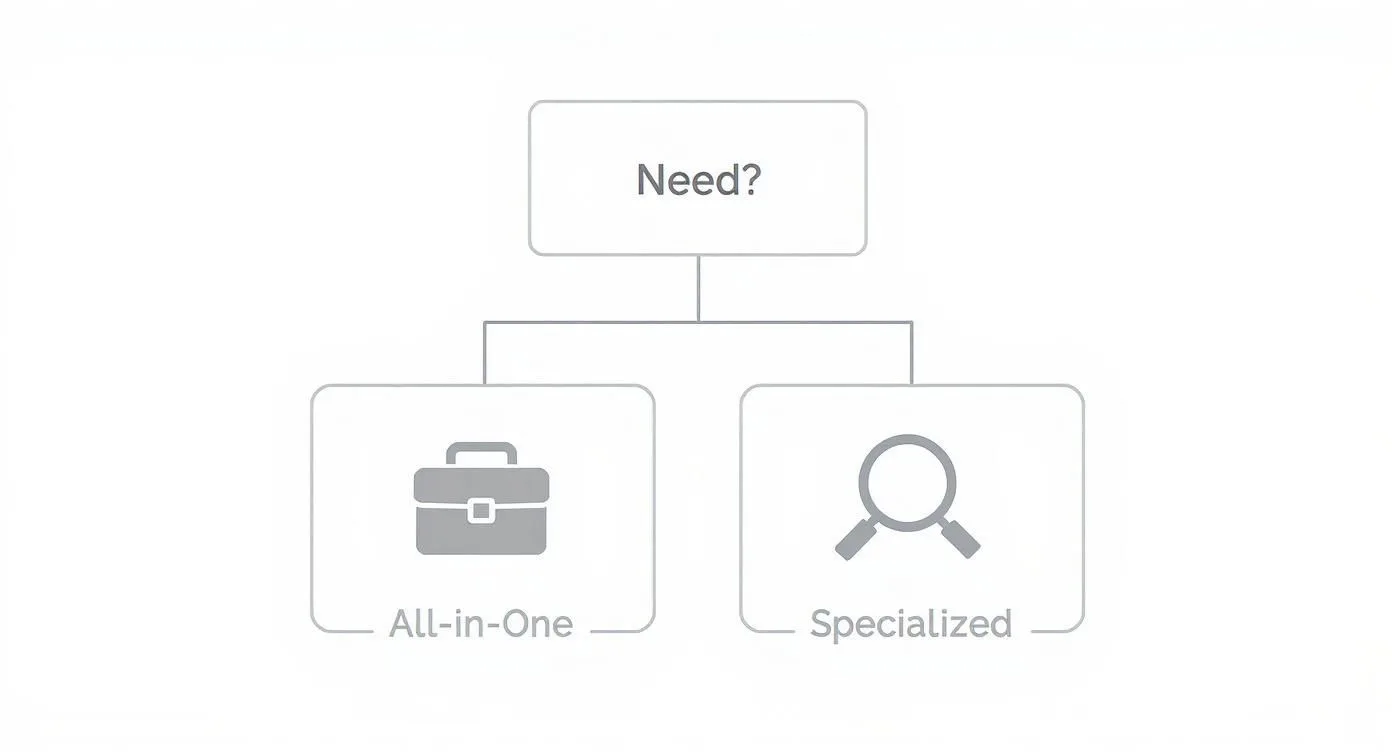
As you can see, choosing between an all-in-one platform and a specialist tool is the most important first step. It stops you from paying for a bunch of features you'll never touch and lines up your software budget with what you actually need to achieve.
Clear Situational Recommendations
To make this very practical, let's walk through a few common startup scenarios. Think of these as clear starting points based on your specific situation.
- You're a solo founder trying to scale quality content without burning out. A specialized tool like SEO Roast is your best move. Its programmatic SEO features let you create targeted content at a scale that the big all-in-one platforms can't match, giving you back your most valuable asset: time.
- You have a small marketing team juggling both SEO and paid ad campaigns. In this case, Semrush is the obvious choice. Its integrated toolkit lets your team manage both from a single dashboard, keeping your paid and organic strategies perfectly aligned.
- Your main goal is to dominate a tough industry with an aggressive link-building strategy. Ahrefs is still the king here. Its backlink data is unmatched, giving you the competitive information you need to build authority and compete with bigger players.
The right tool is the one that removes your biggest roadblock to growth. A solo founder’s biggest problem is usually time and scale. For a small team, it might be coordinating different marketing channels. Match the tool to your problem, not the other way around.
The Future of SEO Software is AI
The SEO software market isn’t just growing; it's exploding, and AI is the reason. Industry reports from 2024 value the global SEO software market at USD 76.8 billion, with projections to hit almost USD 299.6 billion by 2035.
What’s driving this? AI is being built into cloud-based tools, automating everything from keyword research to backlink analysis. You can learn more about the future trends in SEO software from industry research to see just how fast things are changing.
This means the tools of tomorrow will be less like dashboards and more like strategic partners. Expect platforms that don’t just show you data but give you recommendations, predict results, and automate tasks that used to take days.
For founders, this is fantastic news. You’ll be able to get better results with a smaller team and a smaller budget. It makes choosing the right software an even more powerful way to drive growth.
Got Questions? We've Got Answers.
Founders always have questions when trying to pick the right SEO software without spending too much. Let's cover a couple of the most common ones.
This should help clear things up as you finish your seo software comparison and get ready to make a choice.
How Much Should I Budget for SEO Software?
Honestly, there's no magic number. Prices range from less than $50/month** to over **$500/month. For a startup just getting started, think about it this way: your budget should match how much that tool will directly help you reach your main growth goal.
If your focus is on creating a lot of content, then paying for a tool that makes that specific job faster has a very clear return on investment. Don't get drawn into a huge, all-in-one platform if you're only going to use 20% of its features.
When Is It Time to Switch or Upgrade Tools?
It’s time to look for a new tool when you run into one of these three walls:
- The Capability Wall: Your current tool just can't do what you need anymore. Maybe you need much more backlink data than it provides to execute your strategy.
- The Efficiency Wall: You’re spending too much time doing things by hand that a better tool could automate, like internal linking audits or finding competitor content gaps.
- The Data Wall: The insights you're getting just aren't deep enough. You find yourself constantly wishing for more detailed data to decide which keywords to target or what content to create next.
Upgrading isn't about getting distracted by new features. It's about breaking through a real roadblock that’s slowing down your growth.
Ready to stop guessing and start executing with precision? SEO Roast gives you the founder-focused audits and specialized tools you need to turn organic search into a reliable growth engine. Get your actionable plan at https://seoroast.co.