
Mastering Search Intent Optimization
A practical guide to search intent optimization. Learn how to align your content with user needs to drive traffic, engagement, and real SEO results.


Search intent is all about understanding the why behind a search. It’s not just about the words someone types into Google, but what they really want to achieve. When you get this right, you’re not just optimizing for a search engine; you’re giving a real person the most helpful answer possible.
Build the rest of the funnel: how to check backlinks in Google · best on-page SEO tools · best backlink analysis tools · keyword research best practices · how to find broken links on a website · profile backlinks · YouTube CTR and AVD · best link-building tools · SaaS SEO strategy · SEO software comparison.
Why Search Intent Is Your New SEO Superpower
What’s the point of a #1 ranking if everyone who clicks your link immediately leaves? That’s what happens when your content doesn’t match what a user is looking for. Modern SEO is no longer about chasing keywords with high search numbers. It's about satisfying the user's reason for searching.
This is the key difference between getting random traffic and attracting visitors who are ready to learn, engage, or buy. Think of it as a core part of your strategy, not just a clever trick. Google's algorithms are smart, and they reward content that gives users the best experience.
From Keywords to Conversations
Years ago, SEO felt like a contest to see who could stuff the most keywords onto a page. Today, it’s about understanding the conversation your ideal customer is having. What are their problems? What questions are they trying to answer? When you shift your focus to this, you become a problem-solver, not just another content creator.
The goal isn't just to rank. It's to become the most helpful result for a specific need. This is how you build real brand authority and achieve long-term organic growth.
This approach ensures you create content that doesn't just earn a click—it keeps the user on your page. That sends a powerful signal to Google that you’ve successfully met their needs.
The Real Impact on Your Business
Getting search intent right directly impacts your business goals. When your content perfectly matches what a user is looking for, you’ll see clear improvements.
- Higher Engagement: People stay longer and interact more with your content because it’s exactly what they wanted.
- Lower Bounce Rates: A low bounce rate tells search engines your page is a great match for the search, which helps your rankings.
- More Conversions: By meeting people where they are in their journey—whether they’re just starting to research or are ready to buy—you can guide them more effectively to the next step.
Consider this: with over 99,000 Google searches happening every second, the competition for attention is intense. While organic results get most of the clicks, a huge 75% of users never go past the first page. This shows why matching user intent is essential if you want to be seen. This focus is a key part of what search engine optimization is all about.
How to Decode Search Intent Like a Pro
Let's get practical. It's one thing to know the four types of search intent, but it's another to spot them in real searches and know what Google wants to see for each one. The real skill is learning to read the clues in every search.
Think of certain words in a search as a cheat sheet. If you see phrases like "how to," "what is," or "guide," you're almost certainly looking at Informational intent. The person just wants to learn something. A search like "how to choose running shoes" clearly shows they need a helpful article, not a hard sales pitch.
On the other hand, when a search includes words like "buy," "deal," or a specific product like "Nike Pegasus 41 sale," that’s a huge sign of Transactional intent. This person is ready to make a purchase. Showing them a long blog post will only frustrate them.
Looking Beyond the Obvious Keywords
The real magic happens when you look at the queries in between—the ones where someone is interested in buying but isn't quite ready yet. This is where you find Commercial intent.
You can usually spot these by the words people use:
- "Best": As in "best running shoes for flat feet."
- "Review": Like in a search for "On Cloudmonster review."
- "Vs" or "Comparison": For example, "Hoka vs Brooks."
For these searches, people are in full research mode. They want detailed comparisons, honest reviews, and feature lists to help them make a smart choice. Your job is to give them the information they need to feel confident.
And then there's Navigational intent, the easiest one to spot. Someone typing "Amazon" or "YouTube" into Google is just using the search bar to get to a specific website. Unless you are that brand, there’s no point in trying to rank for those terms.
When a Single Keyword Has Multiple Meanings
This is where it gets interesting. Sometimes, a broad keyword can have mixed intent, giving you a chance to create something truly great. Take a simple search like "running shoes." What does that person want? Are they looking to buy now, learn about different types, or read reviews? It could be all of the above.
To figure this out, you need to become a SERP detective. This is why mastering search query analysis is such an important skill for anyone serious about SEO.
Look at what’s already ranking on the first page of Google for your term. If the top results are a mix of store pages, buying guides, and video reviews, Google is telling you that users have different needs for this search.
This is a golden opportunity to build a complete resource that helps everyone. You could create a pillar page about "the best running shoes" that includes:
- Informational Content: Explain topics like pronation, heel-to-toe drop, and different types of shoe cushioning.
- Commercial Content: Offer detailed reviews and direct comparisons of top shoe models.
- Transactional Elements: Include clear links or buttons to product pages where people can make a purchase.
By building a single piece of content that covers these overlapping intents, you're creating something far more valuable. You’re not just answering a single question; you're guiding a user through their entire journey, from curiosity to purchase.
Your Workflow for Intent-Based Keyword Research
Let's be honest: huge lists of keywords are a thing of the past. A winning content strategy isn't built on search volume alone. It's built on understanding the why behind every search.
This means you need a repeatable process that puts search intent at the center of your keyword research. Your job isn't just to download a file from an SEO tool. Your main role is to analyze the SERP (Search Engine Results Page). The SERP is the ultimate source of truth—it’s Google showing you exactly what it thinks is the best answer for a search.
Analyzing the Three Cs of Intent
So, how do you decode the SERP? A simple but powerful framework is the "Three Cs of Search Intent." This helps you quickly figure out what's already ranking and what you need to create to compete.
- Content Type: Are the top results mostly blog posts? Or are they e-commerce pages, product pages, or videos? This is your first major clue.
- Content Format: If blog posts are ranking, what kind are they? Look closer. Are they "how-to" guides, numbered lists ("Top 10..."), reviews, or comparisons?
- Content Angle: What’s the unique hook for the top pages? Common angles are freshness ("for 2024"), a specific audience ("for beginners"), or a key benefit ("on a budget").
This analysis immediately sharpens your focus. For example, if every top result for "best CRM for small business" is a detailed list-based blog post updated for the current year, you know that creating a simple product page for your CRM won't work.
Some SEO tools can give you a head start by tagging keywords with intent types, which helps with initial sorting.
Seeing this kind of breakdown helps you quickly sort a list and prioritize keywords based on whether you're targeting informational, commercial, or transactional searches.
Building Your Content Plan Around Intent
Once you’ve analyzed the SERP for your target keywords, you can build a smarter content plan. Instead of a messy spreadsheet, start grouping keywords by the type of content needed to satisfy them.
The goal is to shift from a keyword-first to an intent-first mindset. You're not just finding a place to use a keyword; you're building the best possible resource to solve a user's problem.
This process completely changes how you create content. Your work becomes strategic and ties back to business goals because you’re attracting the right people at the right time. For a step-by-step guide, check out this comprehensive guide on how to conduct keyword research for SEO.
You can even map these intent-grouped keywords to different stages of the customer journey, from awareness to decision. If you want more hands-on tactics, our guide on free keyword research has some great techniques.
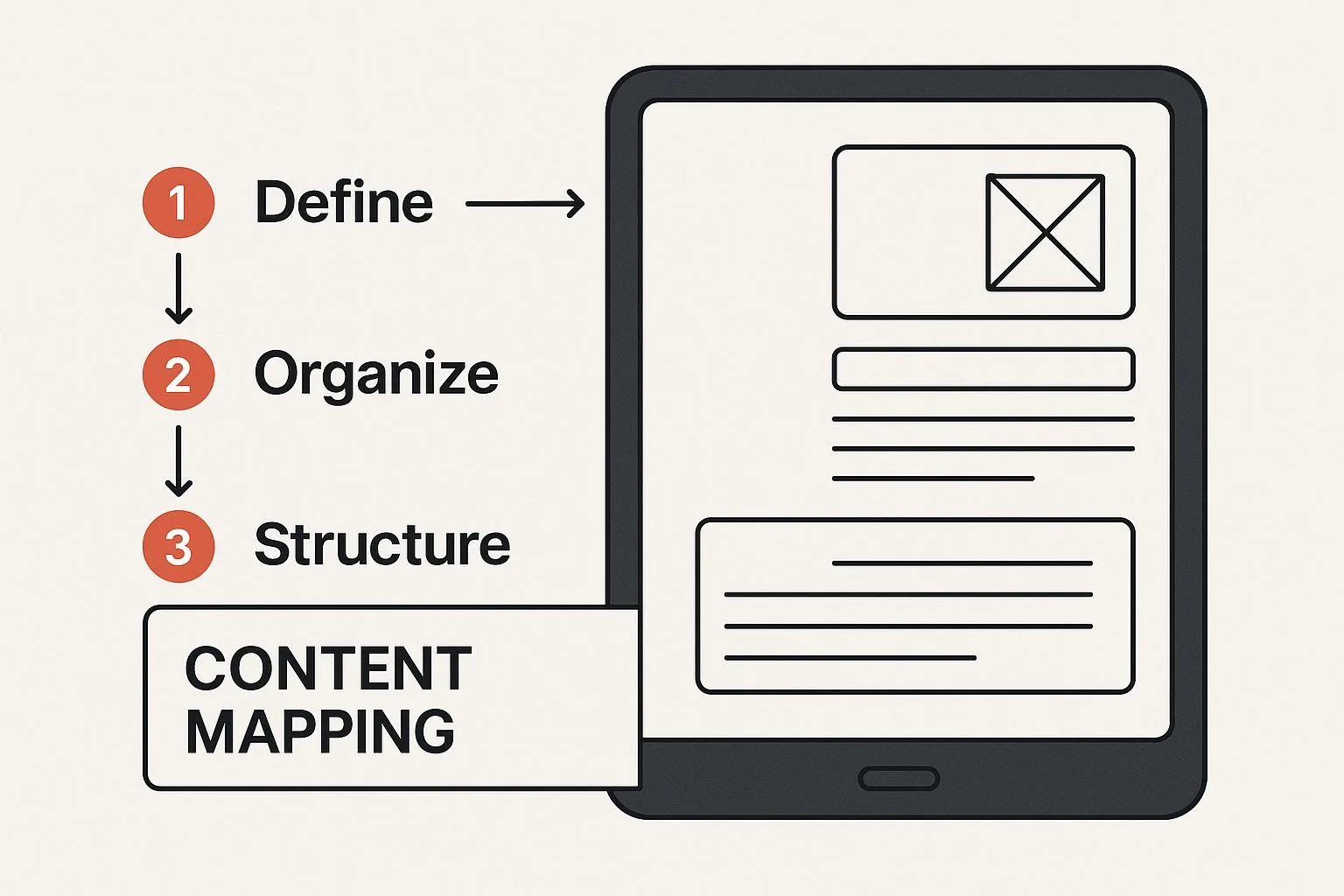
Mapping Content to the User Journey
Great SEO isn't just about matching keywords to a page. It's about meeting a real person exactly where they are in their journey. The most effective way to do this is by mapping search intent directly to the classic marketing funnel.
This simple framework helps you build a guided path that walks someone from their very first question all the way to becoming a customer, instead of just creating random articles.
Think of it this way: each stage of the funnel has a specific job, powered by a different type of search intent.
The Awareness Stage: Informational Intent
At the top of the funnel, people are in learning mode. They have a problem or a question but aren't thinking about specific products yet. Their searches are broad and driven by Informational intent.
They’re asking "what is," "how to," or "why." Your job here is to be a trusted teacher, not a salesperson.
- Content Examples: This is the perfect place for in-depth guides, introductory blog posts, checklists, and explainer videos.
- Real-World Scenario: A new startup founder searches for "how to improve team productivity." The content that will win their click is a helpful guide on different methods, not a hard pitch for your project management software. You're building trust for later.
The Consideration Stage: Commercial Intent
Once someone understands their problem, they move to the consideration stage. Now they’re actively researching and comparing solutions. This is where Commercial intent comes in.
Their searches get more specific, often including words like "best," "review," "comparison," or "alternative."
This is your moment to shine. Your content needs to show your expertise and clearly explain why your solution is a top choice.
Content for this stage needs to be comparative and genuinely helpful. Think of detailed "Project Management Tool A vs. B" posts or an honest review of the "Top 5 CRMs for Small Businesses." You are helping them narrow their options.
This strategy gets a huge boost from localization. Websites that adapt their content to local cultures can see an average 70% increase in organic traffic. Simple technical changes, like using hreflang tags for different languages, can also cut bounce rates by 20%. You can find more SEO statistics at searchatlas.com.
The Decision Stage: Transactional Intent
Finally, at the bottom of the funnel, the user is ready to act. They've done their research and have likely made a choice. Their searches become very specific, showing clear Transactional intent. They might type in "buy [product name]," "[brand] pricing," or "free trial sign-up."
Your only goal here is to make it incredibly easy for them to take that final step.
- Content Needed: This is where product pages, pricing tables, free trial landing pages, and case studies come in.
- Goal: Remove all friction. Guide them smoothly to the finish line.
When you map your content this way, you create a logical journey for your audience. You attract them with helpful articles, guide them with insightful comparisons, and convert them with clear, action-focused pages. It ensures you have the right answer waiting for them at every step.
How Do You Know If Your Intent Strategy Is Actually Working?

So, you've worked hard to align your content with search intent. How do you know if it's paying off? It's easy to focus only on keyword rankings, but that's pointless if the traffic doesn't lead to real business results.
Success isn't just about being #1. It's about being the most useful result for the right person at the right time. That means we need to look past simple metrics and focus on the numbers that prove our strategy is working.
Shifting Focus From Rankings to Behavior
The real proof is in how users behave on your site. When you get the intent right, people stick around. They click deeper, engage with your content, and take the action you want them to.
Here are the key metrics to watch:
- Engagement Rate: This is a great metric in Google Analytics 4 (GA4). It combines things like time on page and conversions to give you a full picture of user interaction. A high engagement rate is a great sign.
- Time on Page: Are people actually reading your content? If someone spends several minutes on an informational blog post, you've likely given them the detailed answer they needed.
- Conversion Rate: This is the bottom line for your commercial and transactional pages. Are those buying guides leading to sign-ups or sales? This is the ultimate test.
- SERP Feature Ownership: Are you capturing valuable spots like featured snippets, "People Also Ask" boxes, or video results? Earning these shows that Google sees your content as a high-quality answer.
Tying It All Together with Your SEO Tools
Your two best friends for this job are Google Search Console (GSC) and Google Analytics 4. They work together to give you the full picture.
GSC is perfect for understanding what happens before the click. You can see the exact searches that bring people to a page, which helps confirm if your intent targeting is right. For example, if a general blog post is ranking for "buy now" terms, you probably have an intent mismatch.
Think of it this way: GSC tells you what promises you're making in the search results. GA4 tells you how well you're keeping those promises once the user is on your site.
When you connect these dots, you can draw a straight line from specific content to real business outcomes. You can show that your helpful guides are bringing in qualified leads or that your comparison articles are directly driving sales.
Learning to read this data is a must-have skill and a core part of how you should learn how to perform a website audit. This data-driven approach doesn't just prove the value of your content—it helps you make smarter decisions for the future.
Sticking Points and Common Questions About Search Intent
Even with a solid process, a few questions about search intent always come up. Let's clear up some common hurdles so you can move forward with confidence.
Isn't This Just Keyword Research?
Not quite. It’s the next step. Traditional keyword research was often a numbers game—find a term with high search volume and low difficulty, and go for it. This approach is simple, but incomplete.
Optimizing for search intent adds the missing "why" behind the search. Instead of just chasing a keyword, you have to look at the SERP and figure out what kind of content Google already considers the best answer. This changes everything. Your goal shifts from just using a keyword to creating the right type of content, whether that's a deep-dive blog post, a product page, or a comparison guide.
Can a Single Page Target More Than One Intent?
Yes, and you often should. A single, powerful piece of content can serve people at different points in their journey. When done right, this makes your content much more valuable.
Think about a guide on the "best running shoes." The main keyword has commercial intent. But within that guide, you can include a section explaining "how to choose the right type of running shoe," which covers informational intent. Then, you can add clear call-to-action buttons linking to product pages where people can buy, satisfying transactional intent.
This strategy is a powerhouse for building authority. You're creating a go-to resource that solves multiple problems in one place. Google tends to reward these comprehensive pages because they do a better job of satisfying a user's entire need on a topic.
What's the Best Way to Figure Out the Intent?
SEO tools are good at labeling keywords, but nothing beats doing a manual SERP analysis yourself. You need to see with your own eyes what Google is actually ranking.
Here’s the best way to get the real story:
- First, open an incognito or private browser window. This is crucial for getting unbiased results.
- Next, type in your target keyword and hit search.
- Now, just look. Carefully study the top 5-10 organic results.
What do you see? Is the page filled with blog posts? E-commerce product listings? A bunch of YouTube videos? The main type of content you see is your clearest signal of what users want and what you need to build to have a chance at ranking.
Ready to stop guessing and build an SEO strategy that drives real growth? SEO Roast provides founder-focused audits and tools to give you a clear, prioritized plan. Get your product discovered by turning organic search into a reliable growth channel. Start your SEO Roast today.