
9 Keyword Research Best Practices for Startups in 2025
Discover 9 actionable keyword research best practices to grow your startup. Learn how to find valuable keywords and turn organic search into reliable growth.


For startups, showing up in search results isn't just another marketing trick; it's a direct line to people actively looking for your solution. But without a smart plan, you're just guessing what customers want. To build a reliable growth engine, you need to understand what your audience is searching for and why. This is the foundation that separates content that gets lost from content that drives steady, high-quality traffic.
This guide gives you a clear, simple playbook of keyword research best practices. We’ll go beyond just chasing big search numbers and focus on strategies that create real business results. You will learn how to figure out what users want, find gaps in the competition, pick the right keywords for your goals, and turn your findings into a content plan that actually works. These are the key steps to turn search engines into a powerful way to get new customers. To really master this skill, check out a complete guide to keyword research for a deeper look.
In this list, we will cover nine important practices:
- Understanding the "why" behind what people search for.
- Checking keyword difficulty to find realistic opportunities.
- Using long-tail keywords to get targeted traffic.
- Doing a full analysis of your competitors' keywords.
- Using a simple system to choose the best keywords.
- Using tools smartly and comparing their data.
- Matching keywords to specific content and user journey stages.
- Tracking your results and updating your strategy.
- Finding chances to get into special search results like featured snippets.
Let's dive into the strategies that will help you match your content with what customers need and drive real growth.
Also on SEO Roast: how to check backlinks in Google · best on-page SEO tools · best backlink analysis tools · how to find broken links on a website · profile backlinks · YouTube CTR and AVD · best link-building tools · SaaS SEO strategy · SEO software comparison.
1. Understand Search Intent Behind Keywords
One of the most important keyword research best practices is to look past the words people type and understand the why behind their search. This is called search intent. It’s the main goal a user has when they search for something. If you don't match your content to their intent, it’s like trying to sell a steak to a vegetarian—you have the wrong product for their needs, no matter how good it is.
Basically, you need to sort keywords into four main types: informational, navigational, commercial, and transactional. Each one fits a different stage of a user's journey. Google is very good at figuring out which content best serves a specific intent. For example, using a long educational blog post to target a "buy now" keyword will almost always fail to rank because you're not matching the user's goal.

How to Decode and Apply Search Intent
Figuring out search intent doesn't need fancy software; you just need to observe. The best way to understand what users want is to see what Google is already rewarding. Search for your target keyword and look at the top 10 results. Are they blog posts, product pages, comparison articles, or videos? The most common content type is your biggest clue.
For a more organized approach, try these simple tips:
- Analyze SERP Features: Look for clues on the search results page. Featured snippets and "People Also Ask" boxes suggest users are looking for information. Shopping ads and product carousels point to an intent to buy. Local map packs show a local or navigational intent.
- Identify Keyword Modifiers: Certain words are strong clues for intent.
- Informational: "how to," "what is," "guide," "tutorial," "benefits"
- Commercial: "best," "top," "review," "comparison," "vs"
- Transactional: "buy," "price," "coupon," "sale," "for sale"
- Map Keywords to Funnel Stages: Match your content to the user's journey. Use informational keywords for top-of-funnel content (awareness), commercial keywords for mid-funnel content (consideration), and transactional keywords for bottom-of-funnel pages (conversion). This ensures you’re helping the user at every step, building trust, and guiding them to a solution.
2. Analyze Keyword Difficulty vs. Opportunity
A key part of smart keyword research best practices is balancing your goals with what’s realistic by checking keyword difficulty (KD). This means figuring out how hard it will be to rank on the first page of Google for a keyword, instead of just chasing high search numbers. Ignoring this is a common mistake that leads teams to spend months creating content for keywords they have no real chance of ranking for, wasting time and money.
Keyword difficulty is a score used by tools like Ahrefs and Moz that measures how strong the pages already ranking for a keyword are. The goal is to find the sweet spot: keywords with enough search demand to be valuable but a low enough difficulty score that your website can realistically compete. For example, a new fitness blog would struggle to rank for "weight loss" (KD 85+) but could get early wins by targeting "weight loss tips for new moms" (KD 35), building its authority over time.
How to Find and Target Your "Sweet Spot" Keywords
Finding keywords with the right mix of opportunity and difficulty is a strategic process, not a guessing game. It requires looking beyond the score itself and manually checking out the competition. A lower KD score often means you can rank faster with less effort, getting quicker wins and building momentum for your SEO strategy.
To find these opportunities in a structured way, use these simple tips:
- Set a Realistic KD Threshold: If your site is new or doesn't have much authority, focus on keywords with a difficulty score under 40. As your site gets stronger, you can start targeting more competitive terms.
- Manually Review the SERPs: Never trust a KD score alone. Search for your target keyword and look at the top-ranking pages. Look for weaknesses: Is the content old? Is the website hard to use? Are there information gaps you can fill? These are your opportunities, even if the KD is not super low.
- Assess Competitor Backlink Profiles: Check the number of unique websites linking to the top 10 results. If every page has hundreds of high-quality links and your site has very few, that keyword is likely too hard for now.
- Prioritize a Mix of Keywords: A good strategy includes a variety of keywords. Target low-difficulty "quick win" terms to get initial traffic and build authority, while also creating great content for tougher keywords that will pay off in the long run.
3. Leverage Long-Tail Keywords for Targeted Traffic
A core part of keyword research best practices is to shift from broad, high-volume keywords to very specific long-tail phrases. These keywords, usually three or more words long, get less search traffic on their own but often have much higher conversion rates. By targeting these specific searches, you connect with users who know exactly what they need and are often closer to making a decision.
While a single long-tail keyword like "best trail running shoes for wide feet under $100" won't bring a flood of traffic, it attracts a perfectly qualified audience. This approach has far less competition than a broad term like "running shoes." Together, all these specific searches can make up most of your search traffic, helping you build authority and bring valuable visitors to your site.
Large-scale analyses of hundreds of millions of keywords show that the vast majority of queries are long tail—specific phrases with modest volume individually but enormous reach in aggregate. That is why ignoring long tail means walking away from most of how people actually search.

How to Find and Apply Long-Tail Keywords
Finding long-tail keywords is about understanding the specific questions and problems your audience has. Instead of guessing, you can use built-in search engine features and simple tools to find these opportunities. A great place to start is Google Keyword Planner and Search Console—we cover how to use tools without over‑trusting a single vendor in section 6.
To use this strategy well, follow these simple tips:
- Analyze SERP Features: Google's "People Also Ask" and "Related Searches" sections are goldmines for long-tail ideas. These are actual phrases users are searching for, giving you a direct look into how they think.
- Explore Question-Based Keywords: Use keyword tool filters to find searches starting with "how," "what," "why," or "where." Creating content that directly answers these questions, like a blog post titled "How to Increase Organic Traffic for a B2B SaaS Company," can attract highly motivated visitors.
- Mine Community Forums: Websites like Reddit, Quora, and industry forums show you the exact language real people use to describe their problems. Look for common questions and phrases to get ideas for your long-tail keywords and content.
4. Conduct Comprehensive Competitor Keyword Analysis
One of the smartest keyword research best practices is to learn from your competitors' success. This means systematically analyzing the keywords they rank for to see what’s working for them and find valuable opportunities you might be missing. Instead of starting from scratch, you can reverse-engineer what's already proven to work in your industry.
This data-driven approach helps you see how you stack up against your rivals and find high-value keywords. By looking at what they rank for, you can get important insights, find gaps in their content that you can fill, and focus on terms that have already shown they can attract the right kind of traffic and customers.
How to Reverse-Engineer Competitor Strategies
Finding your competitors' keywords is easy with modern SEO tools. The goal is to see where they are strong, find terms where they are weak and you can win, and discover the "keyword gaps" where multiple competitors rank, but you don't. This process turns your competitors' SEO spending into your own research.
For a structured approach, try these simple tips:
- Utilize a 'Content Gap' Analysis: Tools like Ahrefs and SEMrush have a "Content Gap" (or "Keyword Gap") feature. Enter your website and 3-5 of your top competitors. The tool will show you a list of keywords that two or more of them rank for, but you don't. This is a goldmine for proven keyword opportunities.
- Identify High-Traffic, Low-Competition Pages: Look for competitor pages that get a lot of organic traffic but don't have many backlinks. These pages often rank for "low-hanging fruit" keywords that are easier to win without a huge link-building effort. This is your chance to create better content and outrank them.
- Create a Competitor Keyword Matrix: Put the keyword data for your top competitors into a spreadsheet. Add columns for search volume, keyword difficulty, relevance, and intent. This helps you sort and prioritize the most important keywords to target first, mapping their successes to your own content plan.
5. Prioritize Search Volume, Relevance, and Business Value
Just chasing high search volume is a common mistake in keyword research. A better approach, and a core keyword research best practice, is to use a simple framework that balances search volume with relevance and business value. A keyword with 10,000 monthly searches is useless if it doesn't relate to your products or attract people who are likely to become customers.
This method forces you to think like a strategist. It means you evaluate keywords on multiple factors to make sure your SEO efforts lead to real business results like leads, sales, and revenue. For example, a B2B software company would be smart to prioritize "enterprise project management software" over the much broader "productivity tips" because the first keyword signals a user with buying power and an immediate need, which directly matches business goals.
How to Implement a Prioritization Framework
Building a system to prioritize keywords doesn't have to be complicated. The goal is to create a consistent, data-informed way to decide which keywords to focus on first. Start by looking at keywords through the lens of their potential return on investment (ROI), not just their potential traffic. This approach helps you avoid a common trap: chasing flashy traffic metrics that do not move revenue.
For a structured approach, try these simple tips:
- Create a Keyword Scoring Formula: Make a simple formula to rank your opportunities, like
(Search Volume × Relevance Score × Conversion Potential) / Difficulty Score. This gives you an objective way to order your keyword list. - Assign Relevance and Value Scores: On a scale of 1-10, score each keyword on two things. First, how closely does it relate to what you sell (Relevance)? Second, how likely is a user searching this term to become a customer (Value)? A local plumber would give "emergency plumber in [city]" a 10 for both, while "how to fix a leaky faucet" might get a 6 for relevance but only a 3 for immediate value.
- Segment by Funnel Stage: Group your keywords by where they fit in the marketing funnel (awareness, consideration, conversion). Prioritize based on your most urgent business needs. If you need sales now, focus on bottom-of-funnel conversion keywords, even if their search volume is lower. This makes sure your content plan directly supports your business goals.
6. Use Keyword Research Tools Strategically and Cross-Reference Data
Relying on just one keyword research tool is a big mistake. A key part of good keyword research best practices is knowing that no single tool is perfectly accurate. Each one uses different data sources and methods, which means you'll see different numbers for search volume, keyword difficulty, and even keyword ideas. The trick is to use multiple tools and compare their findings to get a more complete and reliable picture.
This multi-tool approach reduces the risk of building your whole content strategy on bad data. One tool might be great for checking competitors, while another is better for estimating search volume or spotting trends. By combining their strengths, you can confirm opportunities, spot differences, and make much smarter decisions. This keeps you from wasting time and money on keywords that look good in one tool but have no real potential.
How to Cross-Reference and Validate Keyword Data
The goal isn't to find the "one true number" for search volume, but to get a confident range and understand a keyword's context. Start by getting data from at least two or three different sources and look for where they agree. A keyword that shows high volume in Ahrefs, SEMrush, and Google Keyword Planner is a much safer bet than one with wildly different numbers everywhere.
Here are some simple tips for using multiple tools:
- Establish a "Source of Truth": For keywords you already rank for, use Google Search Console as your main source. It gives you actual impression and click data, which is much more reliable than any third-party tool's estimate.
- Leverage Tool-Specific Strengths: Use each tool for what it does best.
- Competitor Insights: Use SEMrush or Ahrefs to see what your competitors are ranking for.
- Question-Based Keywords: Use AnswerThePublic or AlsoAsked to find long-tail informational questions.
- Trend Validation: Use Google Trends to check if interest in a keyword is growing, stable, or shrinking over time.
- Validate with Manual SERP Analysis: No tool can perfectly predict how hard it is to rank. Always search for your target keyword yourself to analyze the top-ranking pages. Check the authority of competing websites, the quality of their content, and the overall user experience to get a true sense of the competition. For more information, you can explore how a keyword extractor can help pull and analyze SERP data.
7. Map Keywords to Content Types and User Journey Stages
Good keyword research best practices are about more than just finding words; they involve organizing those keywords to create a smooth user experience. This means matching each keyword to a specific stage in the buyer's journey (awareness, consideration, decision) and pairing it with the right content format. This planned approach ensures you build a content system that naturally guides people from their first search to a final purchase.
Instead of randomly creating content for popular keywords, this strategy gives every piece of content a clear purpose. For example, a user in the awareness stage needs educational content, not a sales pitch. By matching keywords with content types like blog posts, comparison guides, and product pages, you meet users' needs at every step. This improves engagement, boosts conversions, and builds a strong, interconnected website.
The diagram below shows a clear framework for mapping keyword stages to the content formats that best fit user intent at each step.
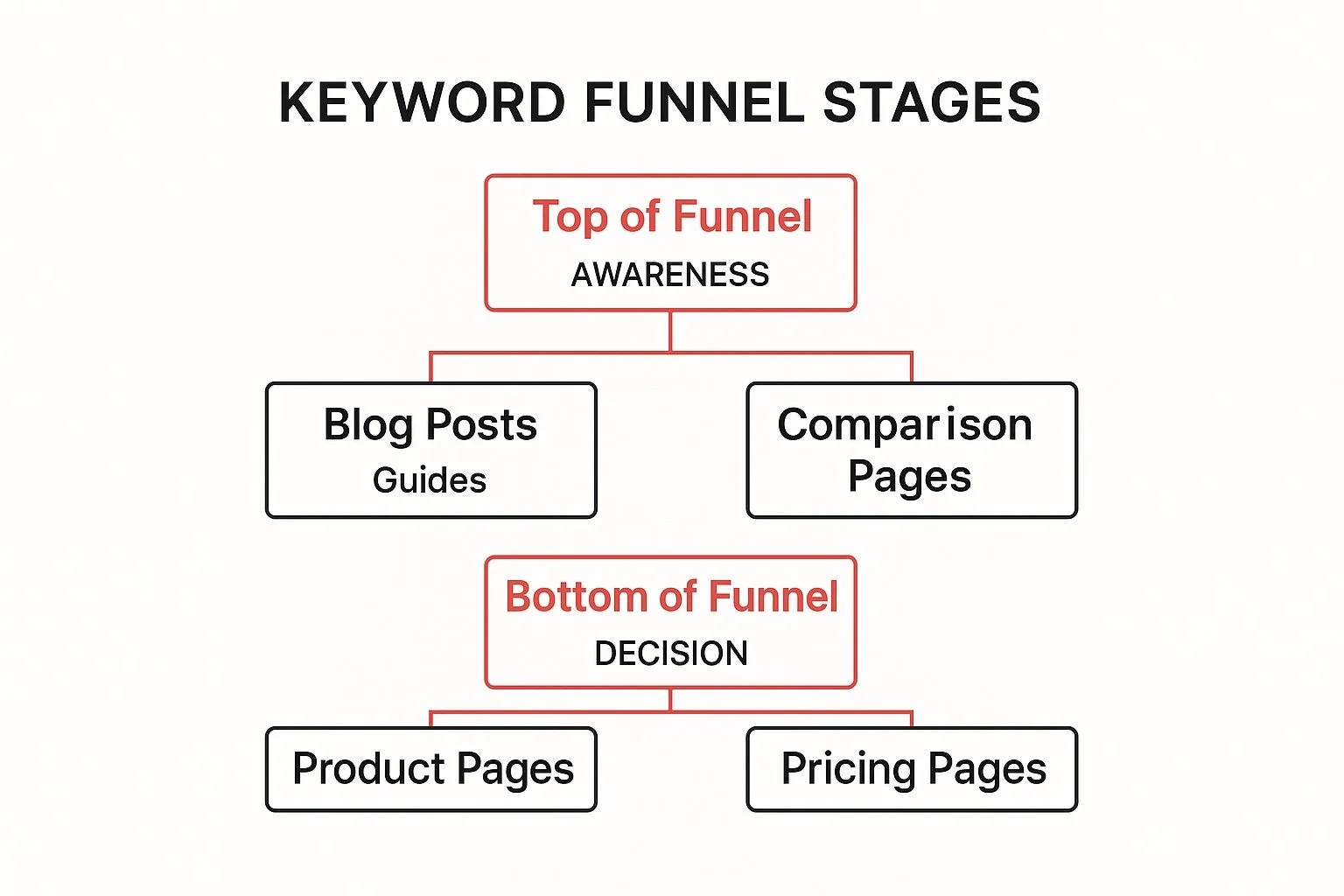
This model provides a simple but powerful blueprint for organizing your content strategy. It makes sure that top-of-funnel users get the information they need, while bottom-of-funnel users are pointed toward making a purchase.
How to Map Keywords to the User Journey
Putting this strategy into action starts with sorting your keywords. The best way to begin is by creating a simple spreadsheet that connects each keyword to its funnel stage, the right content type, and the target URL. This document becomes your content roadmap.
For a more organized approach, try these simple tips:
- Awareness Stage (Top of Funnel): Target broad, informational keywords that start with "what is," "how to," or "why." The best content formats are educational blog posts and in-depth guides. For example, a software company might target "what is project management" with a detailed guide.
- Consideration Stage (Middle of Funnel): Focus on keywords that show comparison, like "best," "review," "vs," or "alternative." This audience is weighing their options, so give them comparison guides, product reviews, and case studies. An e-commerce site might create a "best running shoes for flat feet" article.
- Decision Stage (Bottom of Funnel): Target branded, product-specific, or buying keywords like "[product name]," "pricing," "buy," or "demo." These users are ready to act. Match these keywords with product pages, pricing pages, and landing pages that make it easy for them to take the next step.
- Build Internal Linking Paths: Once your content is mapped out, create logical internal links that guide users down the funnel. A link from a "what is..." blog post (awareness) to a "best software for..." comparison article (consideration) is a natural and effective pathway.
8. Monitor and Refresh Keyword Strategy Based on Performance Data
One of the most important keyword research best practices is to treat it as an ongoing cycle, not a one-time project. A winning strategy needs regular monitoring and updates based on real performance data. Just targeting keywords and hoping for the best is a recipe for failure. You must actively measure what works, what doesn't, and adjust your plan.
This ongoing process involves using tools like Google Search Console and analytics to see which keywords are actually bringing in valuable traffic and sales. By looking at this data, you can find high-potential keywords to focus on, underperforming ones to improve or drop, and new opportunities as they appear. A flexible keyword strategy is key to staying competitive and adapting to algorithm updates and changes in user behavior.
How to Implement Ongoing Keyword Monitoring
The goal is to move from a fixed list of keywords to a dynamic system of improvement based on performance. Your own data is the most reliable source for making smart decisions. Instead of guessing, you can see exactly which searches are bringing users to your site and whether those users are finding what they need.
For a structured approach, try these simple tips:
- Audit Your "Striking Distance" Keywords: Use Google Search Console to find keywords where you rank in positions 5-15. These have high potential, as a small push can often move them onto the first page or into the top 3, leading to big traffic gains. Look for searches with high impressions but a low click-through rate (CTR) to find your best opportunities.
- Identify Your "Power Pages": Find the pages on your site that rank for dozens or even hundreds of related long-tail keywords. These are your content pillars. By identifying these pages, you can plan strategic updates to make them even stronger and capture more related search traffic.
- Set Up a Performance Review Cadence: Schedule monthly or quarterly reviews of your keyword performance. During these reviews, track your main keywords' rankings, traffic, and conversion rates. Look for trends, like seasonal drops in interest (which you can check with Google Trends) or sudden dips that might signal a technical problem or a competitor making a move. This routine ensures you're proactively managing your SEO health.
9. Identify and Target Featured Snippet and SERP Feature Opportunities
An advanced keyword research best practice is to look beyond the standard top 10 blue links and focus on special search results. This means actively finding keywords that trigger things like featured snippets, "People Also Ask" boxes, video carousels, and image packs, then optimizing your content to win these highly visible spots. Getting a featured snippet, also known as "position zero," puts your content above the #1 result and often leads to a big jump in clicks and brand authority.
Ignoring these opportunities means you're competing for a smaller piece of the search results page. Google is becoming more of an "answer engine," and it rewards content that provides direct, clear answers in formats it can easily pull out and display. By structuring your content to win these special features, you can jump ahead of competitors and get valuable traffic, even if you don't hold the top organic spot.

How to Find and Capture SERP Features
Finding SERP feature opportunities is part of modern keyword research. SEO tools like Ahrefs and Semrush let you filter keyword lists to show only those that currently have a featured snippet or other special features. Your easiest wins are often keywords where you already rank on the first page but don't own the snippet.
For a more structured approach, try these simple tips:
- Analyze Your "Low-Hanging Fruit": Use your SEO tool to find keywords where you rank in positions 2-10 and a featured snippet already exists. By re-formatting your content to better answer the user's question, you have a good chance of stealing that snippet.
- Structure Content for Snippet Types: The format of your content is key. Tailor it to the type of snippet you want to win.
- Paragraph Snippets: Answer the question directly in a short 40-60 word paragraph right below a relevant heading (H2/H3).
- List Snippets: Use numbered or bulleted HTML lists with clear, easy-to-read items.
- Table Snippets: Present data in a clean HTML
<table>so Google can easily read it.
- Target "People Also Ask" (PAA) Boxes: Create a dedicated FAQ section on your page. Use schema markup to structure these questions and answers, directly addressing the questions found in the PAA boxes for your target keyword. This helps Google see your content as a complete resource.
9-Key Practices Comparison Guide
| Practice | Implementation Complexity 🔄 | Resource Requirements ⚡ | Expected Outcomes 📊 | Ideal Use Cases 💡 | Key Advantages ⭐ |
|---|---|---|---|---|---|
| Understand Search Intent Behind Keywords | Medium 🔄 - requires analysis of SERPs and modifiers | Moderate ⚡ - time-consuming for large lists | Higher relevance, better rankings, increased conversions | Content planning aligned with user needs and conversion funnels | Improves content relevance, reduces bounce rate, boosts conversions |
| Analyze Keyword Difficulty vs. Opportunity | Medium 🔄 - requires tool interpretation and manual review | Moderate ⚡ - use of keyword tools and competitor analysis | Identify achievable ranking opportunities, prevents wasted effort | Sites assessing ranking feasibility and ROI | Saves resources, realistic goal-setting, finds "quick wins" |
| Leverage Long-Tail Keywords for Targeted Traffic | Low to Medium 🔄 - research intensive but straightforward | Low to Moderate ⚡ - research and content creation | Targeted traffic with higher conversion rates | Newer/smaller sites, niche targeting, voice search | Easier to rank, higher CTR, builds topical authority |
| Conduct Comprehensive Competitor Keyword Analysis | High 🔄 - multiple tools and data synthesis | High ⚡ - subscriptions to competitor tools | Data-driven keyword gaps, content opportunities | Competitive markets needing strategic insights | Uncovers proven targets, reveals content gaps, benchmarks competition |
| Prioritize Search Volume, Relevance, and Business Value | Medium to High 🔄 - requires multi-factor analysis and scoring | Moderate ⚡ - data collection and scoring system setup | Optimized ROI, focused keyword targeting | Businesses aligning SEO with revenue goals | Ensures alignment with business objectives, clear prioritization |
| Use Keyword Research Tools Strategically and Cross-Reference Data | Medium 🔄 - multiple tools and data triangulation | High ⚡ - subscriptions and time investment | More accurate and comprehensive keyword data | Professionals requiring precise data and competitor intelligence | Reduces errors, broadens opportunities, balances tool weaknesses |
| Map Keywords to Content Types and User Journey Stages | Medium to High 🔄 - strategic planning and site structuring | Moderate to High ⚡ - content planning, creation, and auditing | Better conversion rates, improved UX, reduced keyword cannibalization | Sites with diverse content aligning to funnel stages | Enhances site structure, optimizes conversions, supports topical authority |
| Monitor and Refresh Keyword Strategy Based on Performance Data | Medium 🔄 - recurring analysis and optimization | Moderate ⚡ - ongoing analytics and tracking | Dynamic strategy with improved ROI and trend adaptation | All SEO efforts requiring continual refinement | Data-driven decisions, early problem detection, trend responsiveness |
| Identify and Target Featured Snippet and SERP Feature Opportunities | High 🔄 - content adjustment and specialized formatting | Moderate ⚡ - research and targeted content optimization | Increased visibility, "position zero" rankings, higher CTR | Advanced SEO aiming for SERP feature dominance | Boosts traffic beyond traditional rankings, gains voice search advantage |
Putting Your Keyword Strategy into Action
We've covered a full set of keyword research best practices, from basic ideas like understanding search intent to advanced strategies like targeting SERP features and ongoing updates. Mastering these skills is what turns your SEO from a simple checklist into a smart, data-driven engine for long-term growth. It's the difference between blindly chasing popular terms and carefully attracting your ideal customer right when they need you.
The core idea that connects all these practices is a deep understanding of your audience. When you stop thinking about "keywords" as just search terms and start seeing them as signs of human needs, your whole approach changes. You begin to map their journey, predict their questions, and create content that not only ranks but also genuinely helps, converts, and builds brand loyalty.
Synthesizing Your Keyword Research Efforts
To use what you've learned, it's important to see these best practices not as separate tasks but as connected parts of one single strategy.
- Intent as Your North Star: Every keyword you choose must be guided by a clear understanding of user intent. Is the person looking to learn (informational), compare (commercial), or buy (transactional)? This one insight determines your content format, call to action, and overall approach.
- The Balancing Act of Prioritization: Success isn't about finding the single "best" keyword. It's about building a portfolio of opportunities. Your strategy should balance high-volume, competitive terms with highly targeted, lower-competition long-tail keywords. Use a system that weighs search volume, difficulty, relevance, and business value to make smart, efficient decisions.
- A Continuous Cycle of Improvement: Keyword research is not a one-time project. Your market, your competitors, and search engine algorithms are always changing. Having a system to monitor keyword performance, track SERP changes, and refresh your content strategy is essential for long-term success. What works today might not work in six months, making constant analysis your biggest advantage.
From Theory to Tangible Results
Moving from understanding these ideas to putting them into action requires a clear process. Start by reviewing your existing content against your new keyword targets. Find gaps where a new blog post or landing page could perfectly answer a user need you've discovered. For a practical walkthrough of the whole process, look at this detailed guide on how to do keyword research. This resource can help you connect the dots and build a process you can repeat.
By consistently applying these keyword research best practices, you're not just optimizing for search engines; you're building a more customer-focused business. You're creating a powerful feedback loop where audience insights directly shape your product, marketing, and content. This leads to a stronger brand and a more reliable flow of organic traffic, which is essential for any startup where every action must count.
Feeling overwhelmed by the data and need a clear, prioritized action plan? SEO Roast provides concise, high-signal audits for founders and marketers, turning complex keyword research and competitive analysis into a simple, actionable strategy to get your product discovered. Get your SEO Roast and start building a growth engine that works.