
How to Measure SEO ROI for Your Business
Learn how to measure SEO ROI with this practical guide. We cover the formula, metrics, and tools you need to prove the value of your SEO efforts.


Figuring out your SEO return on investment (ROI) uses a simple formula: (Revenue from SEO - SEO Cost) / SEO Cost. The tricky part is finding those numbers. This guide will show you exactly how to do that, so you can prove that SEO isn't just an expense—it's a powerful growth engine for your startup.

Why Measuring SEO ROI Is a Must for Growth
I get it. Trying to explain the SEO budget can feel like a tough sell. Founders and managers want to see real money coming back, not just a traffic chart that looks good.
This is exactly why figuring out how to measure your SEO ROI is a core part of your business strategy, not just a reporting task.
Think of it this way: paid ads are like renting. The moment you stop paying, the traffic stops. SEO is different. It’s a long-term investment that builds a valuable asset for your business. Every blog post you publish and every link you earn adds to your website's authority, creating a steady stream of leads and sales that works for you 24/7.
Shifting the Conversation: SEO as a Strategic Investment
One of the biggest mistakes is treating SEO as just another cost. It's not. You should frame it as an investment in your company's online presence, just like you would a physical store.
When you track your ROI properly, you can finally:
- Justify Your Budget: Show leaders exactly how SEO is helping the business make money.
- Fine-Tune Your Strategy: See which activities (like content vs. link building) give you the best results and do more of what works.
- Forecast Growth: Use real data to predict future revenue and set realistic growth targets.
SEO often delivers one of the highest returns in marketing. On average, you can expect an ROI of $22.24** for every dollar spent. That's far better than paid search, which typically brings in about **$2 per dollar. While other channels work, SEO's true power is its long-term, compounding impact.
To see the full picture, you have to look at how to measure SEO success beyond rankings. Proving its worth is about connecting organic traffic to real business results—like qualified leads, sales, and a higher customer lifetime value. Let's break down how to do that.
On SEO Roast, tighten your inputs with how to check backlinks in Google Search Console, best backlink analysis tools, and an SEO software comparison that matches how you report. Pair those with SaaS SEO strategy, best link-building tools, keyword research best practices, best on-page SEO tools, how to find broken links on a website, profile backlinks, and YouTube CTR and AVD so ROI reflects everything influencing clicks and conversions.
Calculating Your Total SEO Investment
To figure out if your SEO is paying off, you first need to know exactly what you're spending. It's easy to just look at the monthly agency invoice and stop there. But if you do that, your ROI calculation will be wrong—and probably look much better than it really is.
Getting the true cost means adding up every dollar and hour that goes into your SEO efforts.

This comes down to tracking two types of costs: direct and indirect. Direct costs are the obvious ones. Indirect costs are the hidden ones most people forget.
Identifying Your Direct SEO Costs
Let's start with the easy stuff. These are the expenses you can pull straight from your accounting software.
- Agency or Freelancer Fees: The monthly retainer or project fee you pay to an outside SEO partner.
- SEO Tools and Software: Your subscriptions to platforms like Ahrefs, Semrush, or Moz. Don't forget any other tools for rank tracking or keyword research.
- Content Creation: What you paid freelance writers for blog posts, stock photos, or videos.
- Link Building Campaigns: Any budget set aside for earning backlinks, like for sponsored content or outreach services.
Accounting for Hidden and Internal Costs
This is where most businesses miss the mark. Your team's time isn't free—it's a valuable asset with a real cost.
Even if your in-house content manager only spends 10% of their week on SEO tasks, you have to include that portion of their salary in your cost.
A simple way to calculate this is to find an employee's hourly rate (divide their annual salary by 2,080 working hours). Then, multiply that rate by the number of hours they put into SEO each month. This gives you a real dollar value for their time.
And don't forget one-off projects. Maybe your web developer spent 20 hours on technical SEO fixes. That’s a big investment that needs to be tracked.
Adding up these "soft" costs is the only way to get an honest look at your total spending. Once you know your investment, you can start seeing how it affects your traffic. You can get a quick estimate of your organic traffic's value with this free traffic value calculator. It’s a great way to see what your traffic might be worth in paid ad dollars.
Connecting SEO Efforts to Actual Revenue
Knowing your costs is only half the battle. The other half is linking your SEO work directly to the money it brings in. This sounds complex, but it's simpler than you think. You can connect your organic traffic to revenue using a free tool you probably already have: Google Analytics 4 (GA4).
If you run an e-commerce store, this is easy. You can filter your analytics to see exactly how much money came from visitors who found you through a search.
But what if you're a B2B or service-based startup? You aren't selling products from a digital shelf, so you need a different way to measure success.
Assigning a Dollar Value to Your Leads
When you're not an e-commerce business, your main goal is getting leads—like demo requests, free trial sign-ups, or contact form fills. To measure SEO ROI, you must give each of these actions a clear dollar value. This isn’t a guess; it’s a simple calculation based on your sales data.
Here’s a simple formula to figure it out:
- Customer Lifetime Value (LTV): First, determine what a new customer is worth to your business over their entire time with you. For a software company, let's say this is $5,000.
- Lead-to-Close Rate: Next, look at your sales data. What percentage of qualified leads from your website become paying customers? Let's say it’s 10%.
Now, multiply those two numbers: $5,000 (LTV) x 10% (Close Rate) = $500.
In this example, every qualified lead from your website is worth $500 to your business. This number is key to making your SEO value clear and easy to explain to others.
This simple math turns abstract metrics like "form fills" into a clear financial impact. It's a core concept in business intelligence, and understanding measuring ROI and identifying key metrics in BI is vital because the same logic applies to any marketing effort.
This infographic shows how the process works, from tracking organic income to calculating that final lead value.
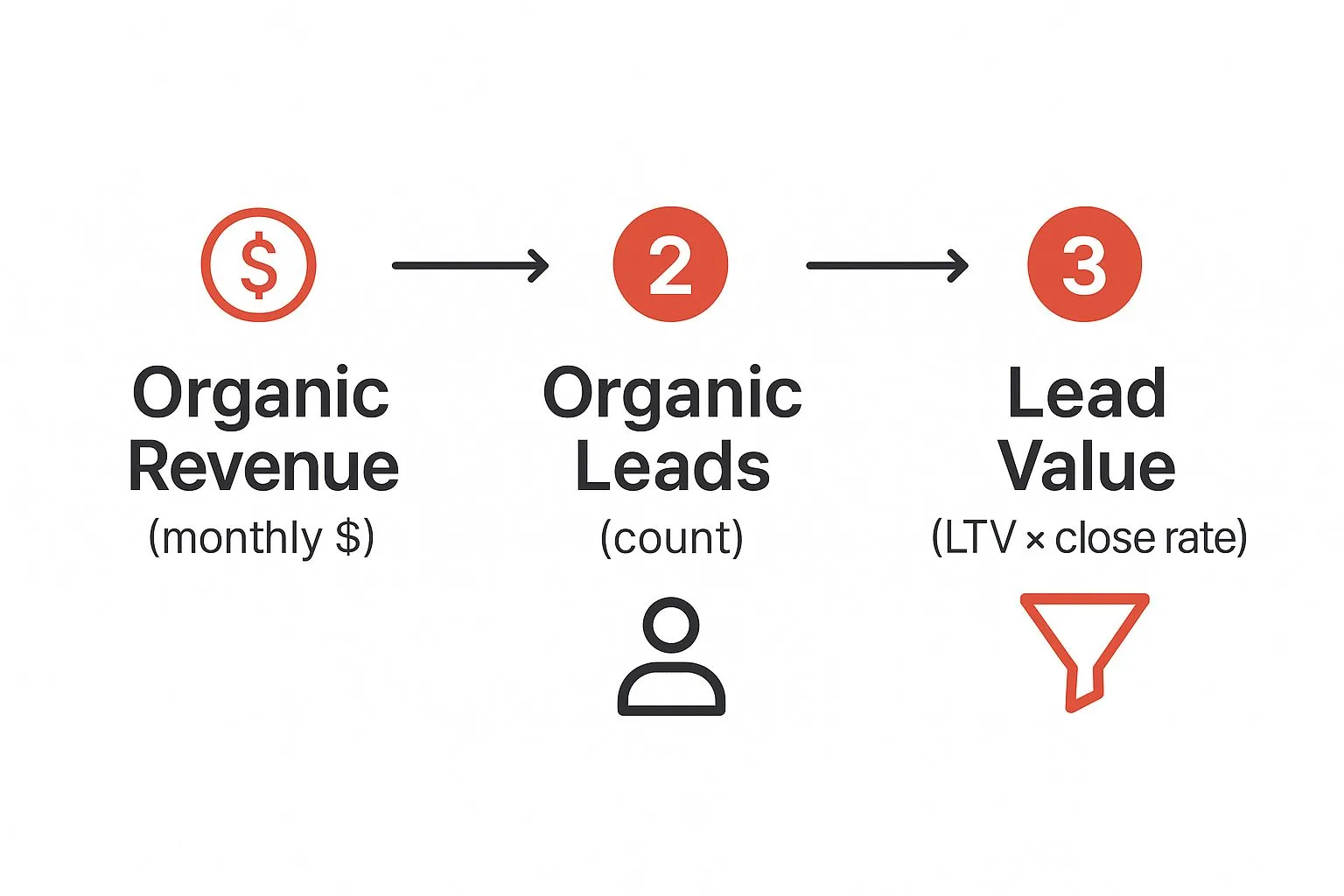
As you can see, the path is clear. Whether you track direct sales or calculated lead values, the goal is always to attach a real dollar amount to your organic traffic.
Using Google Analytics to Find Your Revenue
With your lead value set, you can now use Google Analytics to track your return. One of the key formulas is: (Revenue - Costs) / Costs * 100. E-commerce stores can track revenue from sales directly. Service-based companies can assign their calculated dollar values to events like form submissions.
Inside GA4, you can set up "conversions" for your key lead-generating actions. So, for every organic visitor who requests a demo, GA4 can record a $500** conversion event. At the end of the month, you can see that your SEO efforts brought in, say, 20 qualified leads. That equals **$10,000 in potential revenue.
Tracking these conversions is everything. To do it right, you also need to know which keywords are bringing these valuable visitors. You can check out our guide on keyword research best practices to make sure you're watching the terms that bring in the money. This helps you focus on content that delivers the highest return.
Putting It All Together with Real-World Examples
All this theory is great, but it helps to see it in action. To make sure you know exactly how to measure SEO ROI, let's walk through a couple of common examples.
First, we'll look at an e-commerce store where the money trail is direct. Then, we'll look at a B2B software company, which is a bit trickier since we have to figure out a lead's value first.
Example 1: The E-Commerce Store
Let's say you run an online shop selling phone cases. Your SEO spending is clear, and you can see the revenue coming in directly through Google Analytics.
Here’s your monthly investment:
- SEO Agency Fee: $2,500
- SEO Tool (Ahrefs) Subscription: $179
- Content (2 Blog Posts): $500
- Total Monthly Cost: $3,179
After a month, you check your Google Analytics 4 reports, filter for revenue from the "Organic Search" channel, and see that SEO brought in $12,500 in sales.
Now, we can use our simple ROI formula:
Formula: (Revenue from SEO - SEO Cost) / SEO Cost
Calculation: ($12,500 - $3,179) / $3,179 = 2.93
ROI: 2.93 x 100 = 293%
What does this mean? For every $1** you put into SEO this month, you got **$3.93 back. That’s a fantastic, clear win that anyone on your team can understand.
Example 2: The B2B SaaS Company
Now for a slightly more complex case. Imagine a software company that sells project management tools. They don't sell products directly; their main goal is to get qualified leads to sign up for a demo.
This means we have to do a little math first to assign a dollar value to our return.
First, let's figure out a lead's value:
- Customer Lifetime Value (LTV): $6,000
- Lead-to-Close Rate: 5% (this means 1 out of every 20 leads becomes a customer)
- Value per Lead: $6,000 x 0.05 = $300
Now that we know each qualified lead is worth $300, we can look at the monthly SEO spend.
- In-House SEO Manager (50% of salary): $3,500
- Link Building Budget: $1,500
- Freelance Content Writer: $1,000
- Total Monthly Cost: $6,000
This month, their SEO work generated 25 qualified demo requests from organic traffic. To get the total value, we just multiply the leads by our lead value:
25 Leads x $300/Lead = $7,500 in potential revenue.
Finally, we can calculate the ROI.
Formula: (Value from SEO - SEO Cost) / SEO Cost
Calculation: ($7,500 - $6,000) / $6,000 = 0.25
ROI: 0.25 x 100 = 25%
While 25% might not sound as impressive as the e-commerce example, it's still a positive return. More importantly, it proves that SEO is directly feeding the sales pipeline and gives the team a solid number to improve on next month.
Understanding How SEO ROI Compounds Over Time

One of the biggest mistakes is judging SEO results too quickly. Many people treat it like paid ads, expecting an instant flood of traffic. But that’s not how SEO works.
SEO is an investment that builds on itself. Think of a snowball rolling downhill—it starts small, but it picks up speed and grows bigger over time.
This compounding effect is where the real magic happens. The content you create and the links you build don't just work for a month. They keep working for you, bringing in visitors and growing your site's authority long after you hit "publish."
The Typical SEO ROI Timeline
You have to set the right expectations with your team from day one. You’re not going to see a huge return in the first few months.
In fact, it's normal to see a negative or flat ROI in the first six months, especially if you're starting with a new website. This is when people get nervous and want to stop. Don't.
SEO is a marathon, not a sprint. The real, game-changing value appears when you invest consistently over 12 to 24 months. This is the sweet spot where your content library grows, your backlink profile gets stronger, and Google starts to see your site as a true authority.
This isn’t just a guess; the data proves it. One study of e-commerce businesses found that at six months, the average ROI is only 0.8x. But hang in there. By the 12-month mark, it jumps to 2.6x, and by 18 months, it can hit 3.8x.
After two years of consistent effort, that same initial investment can deliver a sustainable ROI of 4.6x or more as organic traffic becomes a main source of revenue. You can discover more insights about these e-commerce ROI findings and see the numbers for yourself.
Why Compounding Matters for Your Business
When you understand this long-term growth, you can make a much stronger case for continued SEO funding. The conversation changes when you can show leadership that SEO isn't just a monthly expense—it's a compounding asset.
The work you do today builds the foundation for all your future growth.
- Growing Authority: Every new, high-quality backlink you earn makes it easier for your next piece of content to rank.
- Content Library: As you build a library of helpful articles, you start ranking for lots of extra keywords you weren't even targeting.
- Brand Recognition: Showing up at the top of search results consistently builds incredible trust and brand awareness.
Getting this long-term view is key. Before you start a campaign, make sure your website's technical foundation is solid. A great place to start is to use our SEO audit template and fix any issues that could slow down your progress.
Common Questions About Measuring SEO ROI
Even with a good formula, questions always come up when you start applying this to your own business. Let's go through a few of the most common ones.
How Often Should I Calculate SEO ROI?
For most startups, calculating your SEO ROI quarterly is the best approach.
This timeframe is long enough to smooth out the natural ups and downs and account for the delay in SEO results. It gives your new content and links enough time to get indexed, start ranking, and make a real impact.
If you try to report on this monthly, especially in the first six months, you’re just going to stress yourself out. The numbers often look flat or even negative, which can cause unnecessary panic. A quarterly review gives you a much more realistic picture of your progress.
What if My SEO ROI Is Negative?
First, don't panic. A negative ROI in the first 6-9 months of a new SEO strategy is very common. This is especially true if you're starting from scratch with a new site. Instead of seeing it as a failure, use it as a tool to learn and improve.
A negative ROI isn't a signal to quit; it's a signal to check your strategy. It forces you to ask the hard questions that lead to better results.
Here’s how to handle it:
- Double-check your numbers. Make sure you've tracked every cost and revenue source correctly. Simple tracking errors are often the problem.
- Review your strategy. Are you targeting keywords that lead to sales, or just ones that bring traffic? Is your content truly better than what's on page one? Be honest with yourself.
- Give it time. Remember that SEO is a long-term game with compounding effects. A negative return in month five could easily become positive by month ten if you stay on track.
How Do I Track ROI for Content That Does Not Directly Sell?
This is a great question. Not every blog post is meant to get a sale on the first visit. A lot of content is there to build awareness, earn trust, and educate your audience.
The key here is to look at assisted conversions.
Your best friend for this is Google Analytics. Look for the 'Conversion Paths' report (under Advertising > Attribution). This report is a goldmine—it shows you every interaction a user had with your site before they finally converted.
You might find that a blog post you published three months ago was the very first touchpoint for dozens of customers. They read it, left, and then came back two weeks later through a direct search to sign up.
By tracking these paths, you can put a value on your entire content library, not just the pages that get the final click. It’s how you prove that your educational content is helping your business grow, even if it's not directly making sales.
Ready to stop guessing and get a clear, actionable plan to grow your organic traffic? At SEO Roast, we provide founder-focused SEO audits that diagnose your biggest growth opportunities. Get your product discovered.