A Simple SaaS SEO Strategy to Get More Demos
Discover a practical saas seo strategy that drives growth. Master keyword research, content, and link-building to generate more demos.


A good SaaS SEO strategy is more than just marketing—it's a way to grow your business for the long term. The goal is to create a steady stream of good customers who are already looking for software like yours. This focuses on lasting organic traffic instead of expensive ads that stop working when you stop paying.
Why Regular SEO Doesn't Work for SaaS
Let's be honest: the SaaS market is packed with competition. A generic SEO plan won't cut it when you're competing against huge companies and new startups.
For a SaaS business, SEO isn't just another task. It's the best way to get predictable, steady growth. Think about it: when you stop paying for ads, your traffic disappears. But a strong ranking in search results? That's an asset that grows in value, bringing in leads long after you've done the work.
It’s all about turning search traffic into a reliable source of quality leads that helps your business grow.
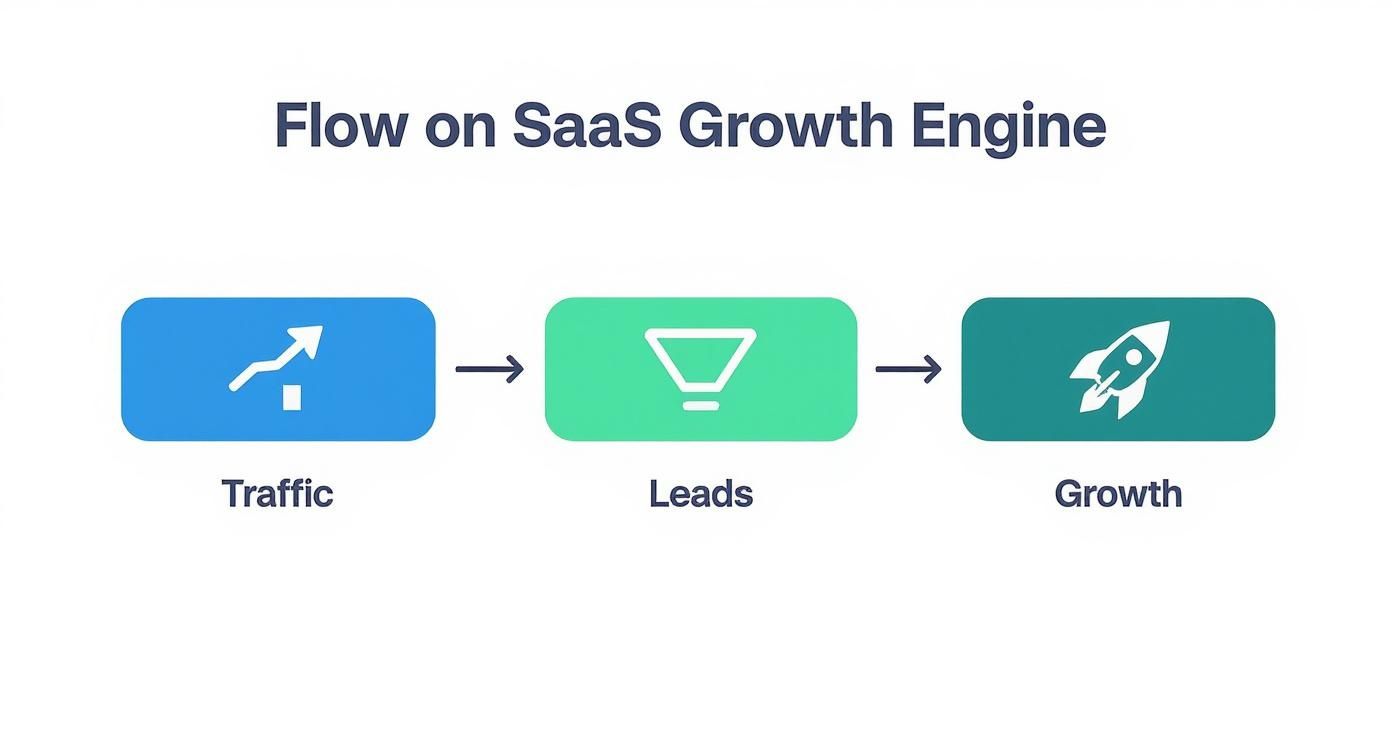
This process shows how a flow of the right kind of traffic, brought in by smart SEO, feeds directly into your sales funnel and pushes your business forward.
The Unique SaaS Customer Journey
What makes SaaS SEO different is understanding how customers make decisions. Your potential users aren't making quick buys; they're trying to solve big, often expensive, business problems.
They go through clear stages—from realizing they have a problem, to looking for solutions, to comparing features, and finally, choosing a service. Your SEO strategy needs to meet them at every step.
This is where a focused saas seo strategy makes a real impact. It’s about matching your content to what users need, making sure you are the helpful, trusted answer they find on Google, whether they're just starting to look or are ready for a demo. It's also useful to see how SEO fits into broader SaaS marketing strategies to understand the whole picture.
The goal isn't just to rank. It's to become a go-to resource for your target audience as they decide what to do. This builds a level of trust that paid ads just can't buy.
The Clear Financial Advantage of SEO
When you look at the numbers, the long-term value of SEO is clear. Paid ads can get you traffic quickly, but they often have high costs for each new customer and provide less value over time. SEO is the opposite—it's an investment that grows.
Recent data shows B2B SaaS companies are seeing an average return on investment (ROI) of 702% from their SEO efforts, breaking even in just seven months. That kind of result is much better than what you get from paid ads.
This strong financial return is why the most successful SaaS companies make search a key part of their growth plan. It's not just about getting traffic; it's about building a more profitable, stable business.
Here’s a quick comparison of how SEO and paid marketing stack up for a SaaS company.
SaaS SEO vs. Paid Marketing at a Glance
This table shows why investing in a long-term SEO strategy is often a smarter financial move for SaaS companies than just relying on paid ads.
| Attribute | SaaS SEO Strategy | Paid Marketing (PPC/Social Ads) |
|---|---|---|
| Cost Over Time | Higher cost at the start, but the cost to get a customer goes down as you gain momentum. | Costs start right away and stay the same or go up as competition increases. |
| Traffic Sustainability | An asset that grows in value. Traffic keeps coming even if you pause spending. | Traffic stops the moment you turn off your ads. You're "renting" visitors. |
| Lead Quality | Usually higher quality because users are actively looking for a solution to their problem. | Can vary. Often targets people by demographics, which may not match their intent to buy. |
| Trust & Credibility | Builds brand authority and trust. Organic search results are often seen as more trustworthy. | Users know it's an ad, which can sometimes lead to less trust. |
| Time to Results | Slower to show results, typically taking 6-12 months to build real momentum. | Can bring in traffic and leads almost instantly. |
| Long-Term ROI | Extremely high. The initial investment pays off for years. | Can be profitable, but the return is tied to how much you keep spending on ads. |
While paid marketing is useful for quick results and testing ideas, you can see how SEO provides a more stable and cost-effective base for long-term growth.
Finding Keywords That Actually Drive Sign-Ups

Let's be clear: a strong SaaS SEO strategy isn't about chasing big search numbers. It all starts with figuring out what your future customers are really typing into Google.
The real goal is to find the exact phrases that show someone is ready to click "start free trial" or "book a demo."
It's about knowing the small but important difference between a user who is just starting to research and one who is ready to buy. They use different words, and you need a plan to attract both.
Moving Beyond Simple Keyword Lists
Too many SaaS teams make a common mistake: they download a huge list of keywords from a tool like Ahrefs or Semrush and stop there. This misses the most important part: user intent. You have to understand the why behind every search.
I like to group SaaS keywords into a few categories that match the customer's journey. This lets you create content that meets people where they are.
- Problem-Aware Keywords: These people know they have a problem but don't know how to solve it. They search for things like "how to reduce customer churn" or "ways to automate team tasks."
- Solution-Aware Keywords: This group knows a tool like yours might exist. Their searches look more like "project management software" or "best email marketing tool."
- Product-Aware Keywords: Now we're getting close. These users are comparing options and are very near a decision. Their searches are very specific: "Acme CRM vs Competitor" or "Acme CRM pricing."
If you only focus on the last group, you're competing for the toughest keywords. A smart strategy creates a full funnel, guiding people from their first question to the final purchase.
Uncovering Your Competitors' Winning Keywords
One of the fastest ways to find good keywords is to see what's already working for your competitors. They’ve spent the time and money to learn what brings in traffic and sign-ups. You can learn from what they've done.
First, identify your top three to five direct competitors—the companies solving the same problem as you. Then, put their websites into your SEO tool. Look for the non-branded keywords that send them the most traffic.
Don't just copy their keyword list. The real value comes from looking at the types of content they create. Are they ranking with long guides, comparison pages, or free tools? This gives you a proven plan for what works in your market.
This process will almost always show you "keyword gaps"—valuable terms your competitors rank for, but you don't. These are easy wins and should be at the top of your content to-do list. For a more detailed guide, check out these keyword research best practices.
The Untapped Goldmine of Customer Language
Honestly, your best keyword ideas won't come from a tool. They'll come directly from your customers. The exact words they use to describe their problems are pure SEO gold.
Why? Because real people use natural, everyday phrases—not the stiff terms you find in keyword tools. These longer keywords are usually less competitive and have a very high conversion rate.
Here are a few places to start looking:
- Support Tickets: What questions does your support team answer again and again? The way customers ask those questions is exactly what they're searching for.
- Sales Calls: Listen to recordings of sales calls. How do potential customers describe their problems before they know what your solution is called?
- Customer Reviews: Go read reviews on sites like G2 or Capterra. The "pros" and "cons" sections are full of the real words your target audience uses.
When you create a system to collect and use this customer language, you find an endless source of high-intent, low-competition keywords that your competitors have likely missed. This is how you build an SEO strategy that truly connects with people.
Building a Content Engine That Attracts Customers

You've done the keyword research. Now it's time for the fun part: turning those keywords into content that brings in customers. A great SaaS SEO strategy depends on its content engine—a reliable system for creating valuable content without burning out your team.
This isn't about quickly publishing a blog post whenever you feel inspired. It's about building a repeatable process that shows you're an expert, attracts your ideal customer, and guides them toward the "Sign Up" button. We're getting strategic. The goal is simple: become the number one resource in your field.
Adopting the Topic Cluster Model
One of the best ways to organize your content is the topic cluster model. It’s a simple but smart idea.
Think of a wheel. In the center, you have a large, detailed "pillar page" that covers a broad topic completely. Then, branching out like spokes, you have "cluster posts"—shorter articles that go deep into specific sub-topics from the pillar page.
Every cluster post links back to the main pillar page. This tells Google that you're an expert on the subject, helping you build authority much faster than a bunch of separate blog posts ever could.
Let's say you have a SaaS for social media scheduling. It might look like this:
- Pillar Page: "The Ultimate Guide to Social Media Marketing" (a huge post covering everything).
- Cluster Posts: Focused articles like "How to Create a Social Media Content Calendar," "Best Times to Post on Instagram," and "Analyzing Your Social Media ROI."
Each of those smaller posts would link back to the main guide. This tells search engines you're a complete source for social media marketing info, which helps you rank for many related keywords.
This strategy shows search engines that you're an authority, not just a surface-level source. By organizing your content this way, you create a network of internal links that boosts the SEO value of every piece you publish.
This structure is great for users, too. It gives them a clear path to follow, keeping them on your site longer and building trust. To do this well, you may want to run a comprehensive CMS systems comparison to ensure your platform can handle this structure easily.
High-Performing SaaS Content Types
While blog posts are important, a smart SaaS SEO strategy uses different content formats to attract people at various stages of their journey. These are the types of content I see get the best results.
Here are a few must-have content types:
- Comparison Pages: These are pure gold. They target high-intent users who are actively comparing their options. A page titled "OurTool vs. Competitor" can bring in qualified leads who are very close to buying. Just be honest and fair—it builds a lot of trust.
- Alternative Pages: Similar to comparison pages, "Competitor Alternatives" content attracts people who are unhappy with another product and are looking for a replacement. You're reaching them at the perfect moment.
- In-Depth Guides and How-Tos: These are your classic problem-solvers for people at the top of the funnel. They target those "Problem-Aware" keywords we discussed, establishing your brand as a helpful expert before they’re ready to buy.
The main takeaway is that every piece of content needs a purpose. Don't just write about a topic. Create something that helps a potential customer solve a real problem or make a better decision. That's how you turn casual readers into paying customers.
Creating Smarter, Not Harder
Consistency is key for content. But being consistent doesn't mean you have to burn out. Research shows that creating just 6-8 high-quality pieces of content each month, organized into topic clusters, can lead to amazing results.
We're talking about a potential ROI of 748%, breaking even in just nine months. That kind of focused effort is much better than creating random content without a plan.
This doesn't require a large team; it requires a good plan. Focus all your energy on one topic cluster each quarter. Even a small team can build serious authority this way.
Instead of trying to be everything to everyone, become the expert on a few key topics that are most important to your product. It’s a step-by-step approach, but it’s how you can outrank bigger competitors by creating a library of content that both users and Google love.
Mastering the Technical SEO That Matters Most
Don't let technical problems ruin your content strategy. A strong SaaS SEO strategy needs a solid foundation, and that means getting the technical details right.
While technical SEO can seem complex, you only need to focus on a few key areas to see a big difference.
Think of your website like a race car. Your great content is the fuel, but if the engine is built poorly, you won't win. Technical SEO is about tuning that engine so Google can find, understand, and rank your content well.
Prioritizing Speed and Mobile Experience
In 2024, site speed isn't optional; it's essential.
Users expect pages to load almost instantly. A delay of just a few seconds will make them leave. This is especially true for mobile users, who make up most of web traffic.
Google knows this and uses Core Web Vitals—a set of metrics that measure loading speed, interactivity, and visual stability—as a key ranking factor. A slow website doesn't just annoy users; it hurts your search rankings.
Your website must be fast, responsive, and work perfectly on any device. Test your site regularly with Google's PageSpeed Insights to find and fix things that are slowing it down.
Crafting a Clean URL and Site Structure
A logical site structure is very important. It helps both users and search engines navigate your website easily. Your URLs should be clean, simple, and descriptive, giving a clear idea of what the page is about.
For example, a URL like yourdomain.com/blog/how-to-improve-team-collaboration is much better than yourdomain.com/blog/post?id=123. The first is easy to read, while the second is meaningless. A well-organized structure also makes it easier to use a strong internal linking strategy.
The Power of Internal Linking
Internal linking is one of the most underrated yet powerful parts of any SaaS SEO strategy. It’s the simple practice of linking from one page on your site to another. When done right, it achieves several important goals:
- Guides Users: It helps visitors find more of your relevant content, keeping them on your site longer.
- Spreads Authority: It passes ranking power between your pages, helping new content get found and ranked faster.
- Establishes Context: It shows Google how your content is related, reinforcing your authority on a topic.
A well-planned SaaS SEO strategy puts a lot of focus on these on-page elements, which can make up around 70% of the total SEO effort. This includes creating content and building a strong internal linking structure to support it.
You can learn more by reading our complete guide on technical SEO best practices.
Using Schema to Stand Out in Search
Structured data, also known as schema markup, is special code you add to your website to help search engines understand your content better. It’s like giving Google a cheat sheet for your page.
This code can unlock "rich results" in Google, making your search listings more eye-catching. For a SaaS business, this is a huge benefit. You can use schema to show things like:
- Product ratings and reviews directly in the search results.
- FAQ sections that answer common user questions.
- Pricing information for your different plans.
This is a great chance to stand out. Using structured data like this can lead to more people clicking on your links from the search results page.
Earning Backlinks That Build Real Authority
If your website is an engine and your content is the fuel, then backlinks are the oil. Simple as that. They make everything run smoother and faster, giving your content the push it needs to climb in search rankings.
To Google, a backlink is a vote of confidence. When a good site links to you, it’s a big signal that you're a trustworthy source. For any SaaS SEO strategy, this is essential for success in a crowded market. But let's be clear: this isn't about using old, shady tricks. It's about earning respect.
Move Beyond Traditional Link Building
The old way of building links was all about quantity. People would beg, buy, or trade for links from any site they could, no matter the quality. That method no longer works and can get you penalized by Google. You don't want that.
As a SaaS company, your goal is to build real authority, not just get a lot of links. This means using long-term strategies that create things people want to link to.
The best links aren't "built." They're earned. You earn them by creating something so valuable or useful that people in your industry naturally want to share it.
Changing your mindset is key. Stop asking, "How can I get a link from this site?" and start asking, "What can I create that deserves a link from them?" That is the core of a modern approach that gets real results.
Create Link-Worthy Assets
The best way to earn high-quality backlinks is by creating "link-worthy assets." These are pieces of content, tools, or data that provide so much value they naturally attract links from journalists, bloggers, and other industry websites.
Here are a few proven ideas that work well for SaaS companies:
- Free Tools & Calculators: Can you build a simple tool that solves a specific problem for your audience? HubSpot's "Website Grader" or CoSchedule's "Headline Analyzer" are perfect examples. These tools are backlink magnets.
- Original Research & Data: Your SaaS is likely sitting on a lot of unique data. Package it into an original industry report. For instance, a project management tool could publish a report on "The State of Remote Team Productivity." Journalists love to cite new, original data.
- Ultimate Guides & Resources: Pick a topic that matters to your customers and create the single best resource on the internet about it. If your competitors have simple "Top 10" lists, you need to create the definitive guide that makes their content look weak. This becomes the go-to resource people will link to for years.
Yes, these assets take more work to create. But the payoff in high-quality backlinks and brand recognition is huge. They are long-term investments that keep providing value.
Strategic Outreach and Guest Posting
Creating a great asset is only half the battle. Now you have to show it to the right people. This is where smart, strategic outreach comes in. Forget sending generic mass emails—focus on building real relationships.
When you publish a new data report, find the journalists and bloggers who have covered similar topics. Send them a personal note. Don't just ask for a link; show them how your new data could improve their next article.
Guest posting is still a powerful tactic, but the goal should be to reach a new, relevant audience—not just get a link. Find the industry blogs where your ideal customers spend their time and pitch a genuinely helpful, non-promotional article.
Give their readers great value. The backlink you get in your author bio is just a bonus. This builds your brand and establishes you as an expert. If you're serious about this, it's worth reading a guide on how to build quality backlinks that explains these modern methods.
Combine amazing assets with smart, relationship-focused outreach, and you'll build a system that consistently earns the kind of backlinks that make a real difference.
Measuring SEO Success Beyond Traffic Numbers
You’ve done the work, built the content, and are following a smart SaaS SEO strategy. That's great. But now comes the big question: "Is it actually working?"
To answer that, we have to look past the simple numbers. Raw traffic numbers can be misleading. Sure, it feels good to see more visitors, but that doesn't pay the bills.
Real success is measured by how many of those visitors turn into actual business. That means tracking the actions that lead to revenue. Before you can measure anything, you need the right tools. That means having Google Analytics and Google Search Console set up correctly. These are essential.
Defining Your Key Performance Indicators
For a SaaS business, the only metrics that really matter are the ones that show a user is getting closer to becoming a customer. Stop worrying about total visitors and start focusing on the growth of business-related actions coming from organic search.
These are the KPIs that will tell you if your SEO is successful:
- Free Trial Sign-ups: This is the most direct link from content to a potential customer. A steady increase here is a strong sign that you're attracting the right kind of traffic.
- Demo Requests: When someone asks for a demo, they are showing clear interest. Tracking this shows that your content for people ready to buy—like competitor comparison pages—is working.
- Marketing Qualified Leads (MQLs): This could be anything from a downloadable e-book to a webinar sign-up. It proves that your educational content is capturing interest and drawing people in.
- Keyword Rankings for High-Intent Terms: You must track your rankings for phrases that show a user is ready to buy. Think of terms like "[Your Solution] alternatives" or "best software for [Problem]." When these rankings improve, lead quality almost always does too.
Your goal isn't just more traffic. It's more of the right traffic—the kind that takes a specific, valuable action. Proving this connection is how you show the real return on investment (ROI) from all your hard work in SEO.
Connecting SEO Efforts to Business Outcomes
Once you start tracking these conversion goals in Google Analytics, the picture becomes much clearer. You can finally draw a straight line from your SEO activities to actual business results.
For example, you can see exactly which blog posts or landing pages are driving the most demo requests. That information is pure gold.
This data becomes your guide. If you find that a certain group of articles is bringing in a lot of free trial sign-ups, what does that tell you? It’s a huge sign telling you to double down and create even more content on that topic.
Ultimately, a successful SaaS SEO strategy is one you can tie directly to revenue. By shifting your focus to metrics like sign-ups and demos, you can make smarter decisions, justify your budget, and build a growth engine that gets stronger over time.
Your SaaS SEO Questions Answered
Look, I get these questions all the time. SEO can feel complicated, so let's clear up a few common ones I hear from SaaS founders.
How Long Until I See SEO Results for a SaaS?
Everyone wants to know this, and the honest answer is: it takes time. You might see some small positive signs in 3-4 months—maybe you'll start ranking for a few longer keywords that aren't very competitive. That's a great start.
But for the real, meaningful results? The kind that bring in a steady flow of leads and rank for important keywords? You need to give it 6-12 months. A solid SaaS SEO strategy is an investment that grows over time, not a switch you flip for instant traffic.
Should We Hide Content Behind a Form for SEO?
This is a common debate. The short answer is: it depends on the content's purpose.
For your general content like blog posts, guides, and articles, keep them open for everyone. The goal here is to get the most reach and let as many people as possible find them. You want Google to easily see and index this content.
Only after you've built trust and provided a lot of value should you consider putting content behind a form. Save this for your most valuable assets—like a unique industry report with original data. That's a fair trade for an email address.
Is Content or Technical SEO More Important?
This is like asking if a car's engine or its wheels are more important. They work together, and you absolutely need both to succeed.
You could write the most amazing content, but if your site has technical problems that Google can't crawl or understand, it's invisible. It will never rank.
On the other hand, a technically perfect website with weak, unhelpful content is just an empty shell. It offers no value to visitors, so Google has no reason to send anyone there. You have to get both right.
Ready to stop guessing and turn your organic search into a real growth channel? Get a concise, high-signal video audit from SEO Roast. Find out what's holding you back and get a clear, prioritized plan to grow. Get your actionable SEO audit here.