
seo how many keywords per page: a simple guide for startups
seo how many keywords per page? Learn the modern, non-spammy keyword targeting approach that helps startups rank higher and attract qualified traffic.


When it comes to SEO, a common question is, "How many keywords should I target per page?" The simple answer is to think less about counting keywords and more about covering a topic. Focus on one main topic per page, then support it with closely related keywords.
Think of your page like a chapter in a book. Each chapter should cover a single, clear subject, giving the reader everything they need on that topic.
The Right Question Is About Topics, Not Keyword Counts

Asking "how many keywords per page" is a bit outdated. Today's search engines are smart. They've moved beyond just matching the words in a search to the words on a page.
Instead, Google tries to understand the reason behind a search and rewards content that gives a complete answer. This means you should focus on topical coverage, not hitting a magic number of keywords. The real goal is to create the best single resource on the internet for that specific topic. This naturally includes all the important points and related questions a user might have.
This focus on quality and depth is a critical ranking factor. The old trick of "keyword stuffing"—repeating a keyword over and over—is dead. It can even get your site penalized for creating a bad user experience.
From Keyword Density to Topical Depth
Remember the days of worrying about "keyword density"? That was the percentage of how many times a keyword appeared on a page. We can officially forget that idea. There is no link between stuffing a keyword into your text and getting high rankings.
In fact, an analysis of over 1,500 Google search results found something interesting: top-ranking pages often have a very low keyword density. For some competitive search terms, pages in the top 10 had an average density of just 0.04%! This proves that search engines care more about relevance and context than simple repetition. If you want to dive deeper, you can learn more about the shift away from keyword density metrics.
The change in SEO strategy is clear. Here’s a quick breakdown of the old way versus the new way of thinking about keywords.
Keyword Strategy Shift: Then vs. Now
| Focus Area | Old SEO Approach (Outdated) | Modern SEO Approach (Effective) |
|---|---|---|
| Primary Goal | Rank for one exact keyword. | Answer a user's question completely. |
| Keyword Tactic | Repeat the target keyword many times. | Cover the topic fully using related terms and synonyms. |
| Content Focus | Narrowly focused on the keyword. | Broadly focused on the entire topic and user's goal. |
| Metric of Success | Keyword count or density. | Quality of info, user engagement, and topic authority. |
| Search Engine View | Repetition showed relevance. | Expertise is shown by giving a complete answer. |
This table makes the change clear. By letting go of old metrics and focusing on creating complete, expert content, you align your strategy with how search engines actually rank pages today. Your page will attract the right people simply by being the best answer to their question.
Understanding Your Primary and Secondary Keywords

To build a page that ranks, you need to get the basics right. Think of each page like a story. Every good story has a main character and a supporting cast. That’s how you should structure your content.
Your primary keyword is the star of the show. It's the central theme your page is built around. This is the main search phrase you want that page to be known for.
Then you have your secondary keywords. These are the supporting cast. They are related terms and subtopics that add depth and context to your story. Their job is to support the main topic and answer the reader's follow-up questions.
How This Looks in the Real World
Let's use an example. Imagine your startup sells project management software for remote teams.
- Primary Keyword: Your main topic is "remote project management software." This is the core focus of your page. It's simple and direct.
- Secondary Keywords: Your supporting cast might include phrases like "best tools for remote teams," "how to manage projects online," and "asynchronous collaboration software."
See what’s happening? The secondary keywords aren't just slight variations. They explore related user problems and ideas that revolve around the main topic. When you include these naturally, you're building a complete resource that tells Google, "This page covers this topic inside and out."
It's Time to Ditch the Old SEO Playbook
This focus on one main keyword supported by related terms is very different from old-school SEO. For years, the advice was to hit a specific keyword density, usually around 1-2%. The idea was to repeat your keyword just enough to get noticed.
That method is dead. Modern search engines are too smart for that simple trick. In fact, SEO research today shows that how often you use a keyword is a weak signal compared to how completely you cover a topic. The average keyword density for top-ranking pages is now less than 0.1%. This proves that natural language and true relevance are what win. You can read more about the new realities of keyword usage on go-seo.com.
The takeaway is simple: Forget about hitting a magic number. Instead, focus on creating a helpful resource that naturally includes your primary keyword and its supporting terms. The goal is to create the best answer for a human, not to please a robot.
Why Search Intent Is Your New North Star
So, you have your list of primary and secondary keywords. The old SEO playbook would tell you to start stuffing them onto a page. Stop right there.
Today, the real starting point isn't what people search for, but why. This "why" is what we call search intent. It’s the most important piece of the modern SEO puzzle. If you get this right, everything else gets easier.
Think of it as the unspoken goal behind every search. When someone types something into Google, they're trying to solve a problem or find something specific. Your job is to be the perfect answer to that goal. If your page doesn't match what they want, you won't succeed—no matter how many keywords you use.
Getting this right helps you stop chasing algorithms and start helping real people. That's the shift that separates content on page ten from content that actually grows your business.
Decoding the Four Main Types of Intent
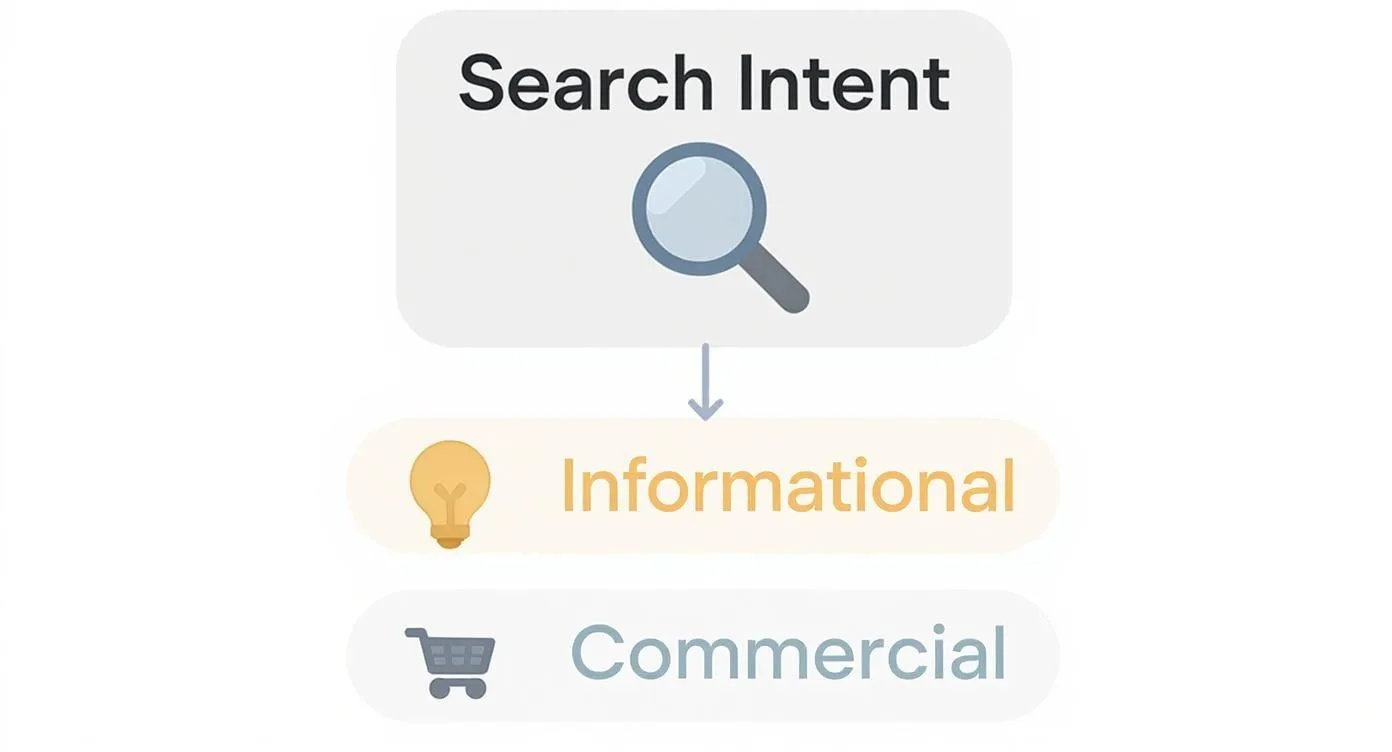
To create content that connects, you have to understand the different "whys" your user might have. Most searches fall into one of four main types. Figuring out which type your keywords belong to helps you decide what kind of page to build.
Let's break them down:
- Informational Intent: This is the "I need to know something" search. The user is in learning mode. Their search might start with "what is" or "how to." A search for "what is an API" needs a clear, educational blog post, not a sales page.
- Commercial Investigation: Here, the user is comparing their options before making a decision. A search like "best payment API for startups" is a classic example. They’re not ready to buy yet, making it a perfect spot for a comparison guide or a detailed review.
- Transactional Intent: This is the money-maker. The user is ready to take action—buy, sign up, or get a quote. Keywords often include words like "buy," "pricing," or "free trial." Someone searching for "Stripe API pricing" is ready to buy and expects a clear pricing page.
- Navigational Intent: This is the simplest of all. The user already knows your brand and is just using Google to get to a specific page. A search for "Stripe login" is a perfect example. They just want the login form, fast.
Correctly identifying search intent is the foundation of a winning SEO strategy. It lets you create the exact content Google wants to show its users, which is the only reliable way to rank.
Now, let's zoom out from a single page and look at the big picture: your entire website. Modern SEO isn't about winning small battles for individual keywords. It’s about winning the war for topical authority.
This means you want Google to see you as the go-to expert on a specific subject. You earn that trust by creating a deep, connected web of content. This shows search engines that your startup truly owns its niche, making you a more credible source.
How to Build Authority With The Pillar-Cluster Model
A great way to do this is the pillar-cluster model. You're basically building a mini-encyclopedia on your site for a topic that's key to your business.
Here’s how it works:
- The Pillar Page: This is your big, foundational guide. It covers a broad topic from start to finish. For a startup, this might be something like, "The Ultimate Guide to Startup Funding." It's long and covers all the major points.
- Cluster Content: These are smaller, focused articles that dive deep into the subtopics from your pillar page. Each one links back to the main pillar. So, you might have articles on "Seed Funding Basics," "How to Pitch VCs," or "Understanding Term Sheets."
This structure does two great things. First, it creates a strong network of internal links, which signals to Google that you have a deep understanding of the subject. Second, it gives your readers a clear path to follow as they learn.
By organizing your content this way, you’re not just chasing keywords; you're building a resource that helps people while proving your expertise to search engines.
Why Authority Is The New Ranking Factor
This whole shift away from just counting keywords makes sense. Google cares most about user satisfaction. Recent data on what really affects search rankings is very telling.
Consistently publishing high-quality, helpful content now accounts for 23% of the ranking weight. That's a huge piece of the pie. It's more important than old tactics like keyword placement in titles (14%) or even backlinks (13%). The data is clear: an authority-first approach is essential.
Building topical authority is a long-term game. It’s about creating a true asset for your business—a library of valuable content that attracts and helps your ideal customers, making your startup a trusted leader in your field.
Of course, to do this, you need to know what your competitors have already covered and where the opportunities are. This is where a good competitive analysis becomes your best friend, helping you choose the topics you can win.
A Practical Framework For Keyword Mapping
Putting this all into practice doesn't have to be hard. What you need is a simple, repeatable process that works.
Let’s walk through a simple framework for mapping keywords to your content. This approach ensures every article has a clear job to do.
Step 1: Start With Your Core Pillar Topics
Before you use a keyword research tool, step back. What are the 3-5 big topics your business is all about? Think of these as your content pillars.
For a SaaS company that sells project management software, these pillars might be "Project Management," "Team Collaboration," and "Productivity Workflows." These are the core subjects you want to own.
Step 2: Brainstorm Real-World User Questions
With your pillars defined, think like your customer. For each pillar, what questions are they actually asking? What problems are they trying to solve? Don't worry about perfect SEO phrasing yet.
Let's take the "Team Collaboration" pillar. Your brainstorm might look like this:
- How can I get my remote team to communicate better?
- What are the best ways to share files securely?
- How can we make virtual meetings better?
- What’s the difference between synchronous and asynchronous work?
Each of these questions is a potential "cluster" article that answers a specific user need.
This question-first approach is the secret. It forces you to lead with search intent. You're not guessing what people want; you're directly addressing their problems, which is exactly what Google wants to reward.
Step 3: Let Google Tell You What to Write
Now that you have your questions, it’s time to find the keywords. You don’t need an expensive tool to start. Google is your best friend.
Type one of your questions into the Google search bar and scroll down to the "People Also Ask" box. This section is a goldmine. It's Google giving you related subtopics and secondary keywords that real people are searching for.
For a search like "how to improve remote team communication," you might find gems like "What are the 5 Cs of communication?" or "How do you build team morale remotely?"
Boom. Those are your secondary keywords. They give you a ready-made outline for your article, ensuring you cover the topic from all angles.
Step 4: One Page, One Primary Job
Okay, let's bring it all together. The final step is to map it out. The golden rule is simple: one primary topic per page.
Each user question becomes the primary keyword target for a new blog post. The related questions you found in "People Also Ask" become your secondary keywords and subheadings within that article.
Here’s a quick look at how this might work for a SaaS startup.
Keyword Mapping Example for a SaaS Startup
This table shows how a company could map different content pieces, each serving a specific user intent while building authority around the "Project Management" pillar.
| Content Type | Page Title / Topic | Primary Keyword | Secondary Keywords / Subtopics | User Intent |
|---|---|---|---|---|
| Pillar Page | The Ultimate Guide to Project Management | project management guide | project management basics, project management methodologies, benefits of project management | Informational (Broad) |
| Cluster Post | How to Create a Project Timeline | create a project timeline | project timeline template, steps to make a timeline, software for timelines | Informational (Specific) |
| Cluster Post | Asana vs. Trello: Which is Better for Small Teams? | asana vs trello | asana features, trello pricing, best project tool for startups | Commercial (Investigation) |
| Landing Page | The Best Project Management Software | best project management software | top project management tools, project management software reviews, affordable PM software | Transactional |
This simple process prevents your content from competing with itself and creates a logical site structure. It turns your strategy into a practical content plan that both users and search engines will love.
How to Actually Measure Your Keyword Success
Alright, you've done the work. You’ve built content around topics and search intent. But how do you know if it's actually helping your business?
You can't afford to get lost in vanity metrics. You need to focus on what ties your SEO efforts to growth.
First, you need to track your visibility. You don't need fancy software to start. Google Search Console is a free, powerful tool that shows you exactly which searches your pages are showing up for and their average ranking positions. It’s your source of truth.
From Rankings to Revenue
Seeing your site climb the rankings is great, but it doesn't pay the bills. You need to connect that visibility to real business results. Track a few key metrics that tell the full story.
Here’s a simple way to think about it:
- Organic Traffic: Are more people finding your page from Google over time? An upward trend is the first sign your strategy is working.
- Engagement: Once they land on your page, do they stick around? Check metrics like time on page. If people are reading and scrolling, it’s a strong signal that your content is solving their problem.
- Conversions: This is the bottom line. Is your content traffic turning into free trial sign-ups or demo requests? Tracking conversions proves the ROI of your work.
Successful keyword targeting is a core part of bigger business goals. Understanding this is key for mastering organic lead generation strategies.
By focusing on traffic, engagement, and conversions, you move beyond asking "how many keywords per page" and start answering the more important question: "How is my content growing my business?"
A Few Lingering Questions About Keyword Targeting
Even with this modern approach, a few old questions still come up. Let's clear the air on some common ones.
Should I Still Worry About Keyword Density?
Honestly? No. The old practice of trying to hit a specific keyword density, like 1-2%, is outdated and can hurt your content.
Instead of counting, focus on placing your primary keyword naturally in a few key spots: your page title, the opening paragraph, and maybe a subheading. The goal is to signal relevance clearly, not to hit a quota. Write for your reader first, and Google will understand.
How Many Secondary Keywords Should I Use on a Page?
There's no magic number. Think of secondary keywords as the subtopics needed to tell the whole story.
For instance, if you're writing a guide on "how to make cold brew coffee," you’d naturally talk about "best coffee beans," "cold brew ratio," and "different brewing methods." You include as many as you need to create a complete and helpful resource. If a related term feels forced, leave it out.
Your page isn't a bucket you fill with keywords. It's an answer to a person's question. If you focus on solving that problem completely, you'll use the right keywords without even trying.
Can One Page Rank for Multiple Keywords?
Absolutely. In fact, it's a sign that you're doing things right. This is usually the natural result of creating great content.
A well-written page targeting a primary keyword will almost always start ranking for dozens of related long-tail searches. A page on "best project management software for startups" will also start to get traffic for "top project tools for small teams."
The takeaway? Focus on creating the single best resource on the web for your one core topic. When you do that, you'll naturally attract a whole range of relevant search traffic.
Ready to stop guessing and get a clear, actionable plan to grow your startup's organic traffic? SEO Roast provides founder-focused SEO audits and tools that deliver results. Get your personalized SEO teardown at https://seoroast.co.