A Founder's Guide to SEO for SaaS Startups
Unlock scalable growth with our guide on SEO for SaaS startups. Learn actionable strategies for keyword research, content, and link building that actually work.


Paid ads are a quick fix. You get fast results, but they stop the moment you stop paying. SEO for SaaS startups, on the other hand, is a long-term growth plan that builds a steady stream of interested customers.
Think of it as building an asset. It grows over time, bringing in value long after the initial work is done.
Why SEO Is Your SaaS Startup's Secret Weapon
Many new companies fall into the paid ad trap. It makes sense when you need traffic now. But the problem is clear: stop paying, and your traffic disappears. This burns through cash without building anything that lasts.
SEO is about showing up where your customers are already looking for solutions.
This isn't just about getting traffic; it's about turning your website into a tool that generates leads for you 24/7. Every article you publish and every link you earn becomes a small digital salesperson, bringing in good prospects day and night.
This creates a powerful growth cycle:
- Sustainable Growth: A well-ranked article can bring in traffic and leads for years, not just during a short campaign.
- Higher Trust: People trust organic search results more than ads. This trust leads to better quality leads.
- Lower Customer Acquisition Cost (CAC): Over time, as your content ranks higher, your cost to get a new customer from SEO drops.
Look at this graph. It shows the typical organic traffic growth for a SaaS company. It starts slow, but it builds until it becomes the main source of traffic.

That upward curve shows what consistent SEO can do. It builds momentum that paid ads just can't match.
The Compounding Value of Organic Search
Here’s a simple way to think about it: Paid ads are like renting. The moment you stop paying, you're out. SEO is like buying a house. Your ownership—in this case, your site's authority—grows over time, making your asset more valuable each year.
The financial benefit is huge. For B2B SaaS companies, the average SEO ROI is an amazing 702%, and you usually break even in about seven months. It's one of the best marketing investments you can make. If you want to learn more, these B2B SaaS SEO stats show a very clear picture.
This long-term value is key, especially as search engines change. A strong organic presence helps your brand stay visible, no matter how people find information in the future.
When you focus on solving your customers' problems with great content, you're not just trying to rank higher. You're building a brand that both search engines and people will trust.
Building Your Technical SEO Foundation
Before you can rank on page one, you need to make sure your site is set up correctly. This means ensuring search engines can find, crawl, and understand your website. This is what we call technical SEO.
Think of it like the foundation of a house. If it's weak, it doesn't matter how great the rest of the house is—everything built on top is at risk.

Getting this right isn't about being a coding expert. It’s about making sure a few key things are set up correctly. A solid technical setup ensures all your future content and link-building efforts aren't wasted.
Crafting a Logical Site Structure
Your website’s structure is its roadmap for both people and search engines. A confusing layout frustrates visitors and makes it hard for Google to know which pages are important. For a SaaS startup, a clean, simple structure is essential.
The goal is to create clear paths. A visitor should be able to land on your homepage, find a specific feature, and then see your pricing without feeling lost. This logical flow is good for users and helps spread authority across your site.
Here's a simple structure that works well:
- Homepage: Your main entry point.
- Features: Pages that explain what your software does.
- Solutions/Use Cases: Pages for specific customer types or problems (e.g., "Time Tracking for Freelancers").
- Pricing: A clear breakdown of your plans.
- Blog: The home for your educational content.
This structure makes your site easy to navigate, which is a big win for both users and search engines.
A well-structured website guides Google through your content just like it guides a customer. If a user can’t easily find your pricing page, a search engine crawler will likely struggle, too.
Nailing the Technical Essentials
Besides structure, a few technical basics are crucial for SEO. These things signal your site's quality to search engines and improve the user experience. You can't skip them.
Site Speed and Mobile-Friendliness Nobody waits for a slow website to load. Google knows this and uses page speed as a ranking factor. Also, since most searches happen on phones, your site must work perfectly on mobile devices.
XML Sitemaps and Schema Markup An XML sitemap is a list of all your important pages that you give to Google. It’s a simple way to say, "Here's all my content, please don't miss anything!"
Schema markup is more advanced but very powerful. It’s extra code that helps search engines understand the context of your content. For a SaaS company, you can use it to tell Google about your product, its features, and customer ratings. This can lead to eye-catching "rich snippets" in search results.
These aren't one-time tasks. You need to monitor them as your site grows. A strong technical foundation makes every other part of your SEO strategy more effective.
Finding Keywords Your Customers Actually Use
Good SEO isn’t about guessing what people search for. It's about understanding the exact words your ideal customers use when looking for a solution. This is how you start a direct conversation with someone who needs your product.
Your keyword strategy is the roadmap for your content plan. You need to know what customers are thinking when they first realize they have a problem, when they compare options, and when they are ready to buy.
Aligning Keywords with Customer Awareness
At the core of a good keyword strategy is search intent—the "why" behind every search. I break this down into three stages of awareness. Each stage needs different content and keywords.
- Problem-Aware Keywords: These people know they have a problem but don't know a solution like yours exists. They search for questions like "how to automate team workflows" or "best way to manage customer feedback." Your goal is to provide helpful blog posts that solve their problem and introduce your brand as an expert.
- Solution-Aware Keywords: Now, they know solutions exist and are comparing them. Keywords become more specific, like "asana vs monday" or "project management software." Here, you should create comparison pages or feature breakdowns that show why your tool is the better choice.
- Product-Aware Keywords: This is the final stage. The person knows what they want and is ready to buy. They use phrases like "crm software for small business" or "[Your Competitor] alternative." These keywords are perfect for your main landing pages and pricing page because they attract people who are ready to sign up.
By matching your keywords to these stages, you create a content funnel that meets people where they are.
Uncovering High-Value Keyword Opportunities
So, how do you find these keywords? It’s a mix of creative thinking and data analysis. Don't just type a word into a tool and stop there.
A great starting point is to look at your competitors. Use a tool like Ahrefs or Semrush and enter a competitor's website. You'll see the exact keywords that bring them traffic. Look for gaps. Are they on page two for a valuable term you could target? That's your chance.
The goal isn't just to make a huge list of keywords. It's to create a strategic keyword map that guides your entire content plan. This way, every article has a clear purpose and audience.
The data shows this works. In 2025, SaaS companies that create content regularly start ranking for 1,200 to 2,000 keywords within six months. Also, long-tail keywords—longer, more specific phrases—now bring in about 68% of all SaaS organic traffic. This shows that people are getting more specific with their searches.
Building Your Strategic Keyword Map
Once you have a good list of keywords, it's time to organize them. Group them into logical clusters based on topics and intent. This helps you build topical authority and show Google you're an expert.
For example, if you have a time-tracking tool, you could build a topic cluster around "employee productivity." Inside that cluster, you might have:
- A problem-aware keyword like "how to measure team productivity" for a blog post.
- A solution-aware keyword like "best employee time tracking apps" for a comparison page.
- A product-aware keyword like "simple time tracking software" for a feature page.
Let's look at how you can map different types of SaaS keywords to your content goals.
SaaS Keyword Types and Content Mapping
This table shows how to connect different keyword types to the right kind of content. It’s a simple way to link user intent directly to your content strategy.
| Keyword Type (User Intent) | Example Keyword | Ideal Content Type | Goal |
|---|---|---|---|
| Problem/Informational | "how to improve team collaboration" | Blog Posts, How-To Guides, Free Templates | Educate, build trust, and attract new visitors. |
| Solution/Comparison | "slack vs microsoft teams" | Comparison Pages, Alternative Pages, "Best of" Lists | Position your product against competitors and help users decide. |
| Product/Transactional | "project management software" | Product Feature Pages, Use Case Pages, Pricing Page | Drive sign-ups and demos from users ready to buy. |
| Branded/Navigational | "[Your Brand Name] pricing" | Homepage, Pricing Page, Login Page | Help existing or interested users find what they need. |
| Competitor Branded | "[Competitor] alternative" | "Alternative to X" Landing Pages, Direct Comparison Pages | Attract users looking for an alternative to your competitor. |
Mapping keywords this way ensures every piece of content has a clear business purpose, from building awareness to driving sales.
This organized approach ensures your content is all connected. For more details, check out these keyword research best practices.
To get this right from the start, learning how to choose keywords for SEO that match your business goals is essential. This skill helps you pick the keywords that will actually grow your startup.
Creating Content That Attracts and Converts
Keyword research gives you the map, but great content is what drives your SEO strategy forward.
For a SaaS startup, content does more than just rank on Google. It turns a curious searcher into a paying customer. It’s how you prove you understand their problems and build the trust needed for them to buy your software.
To stand out, you need to create engaging content that gets results. Stop talking about your features and start showing how you solve your audience’s biggest problems.
Building Your Content Hub
A very effective way for SaaS companies to own a topic is with the hub and spoke model. Think of it as creating a complete library on a subject. This signals to search engines that you have deep knowledge in that area.
Here's how it works:
- The Hub (Pillar Page): This is a long, detailed guide covering a broad topic related to your product. For a project management tool, a hub could be "The Ultimate Guide to Agile Project Management."
- The Spokes (Cluster Content): These are shorter articles that dive deep into specific sub-topics from the hub page. Examples include "How to Run an Effective Sprint Retrospective" or "The Best Tools for Kanban Boards."
Every spoke article links back to the main hub page. This network of internal links tells Google that your pillar page is the main source of information, making it easier for users to learn more on your site.
Matching Content to the Buyer's Journey
People search differently depending on how close they are to buying. Your content needs to be there at every stage, guiding them from "I have a problem" to "I'm buying your solution."
This infographic shows the typical stages and the kinds of keywords people use.
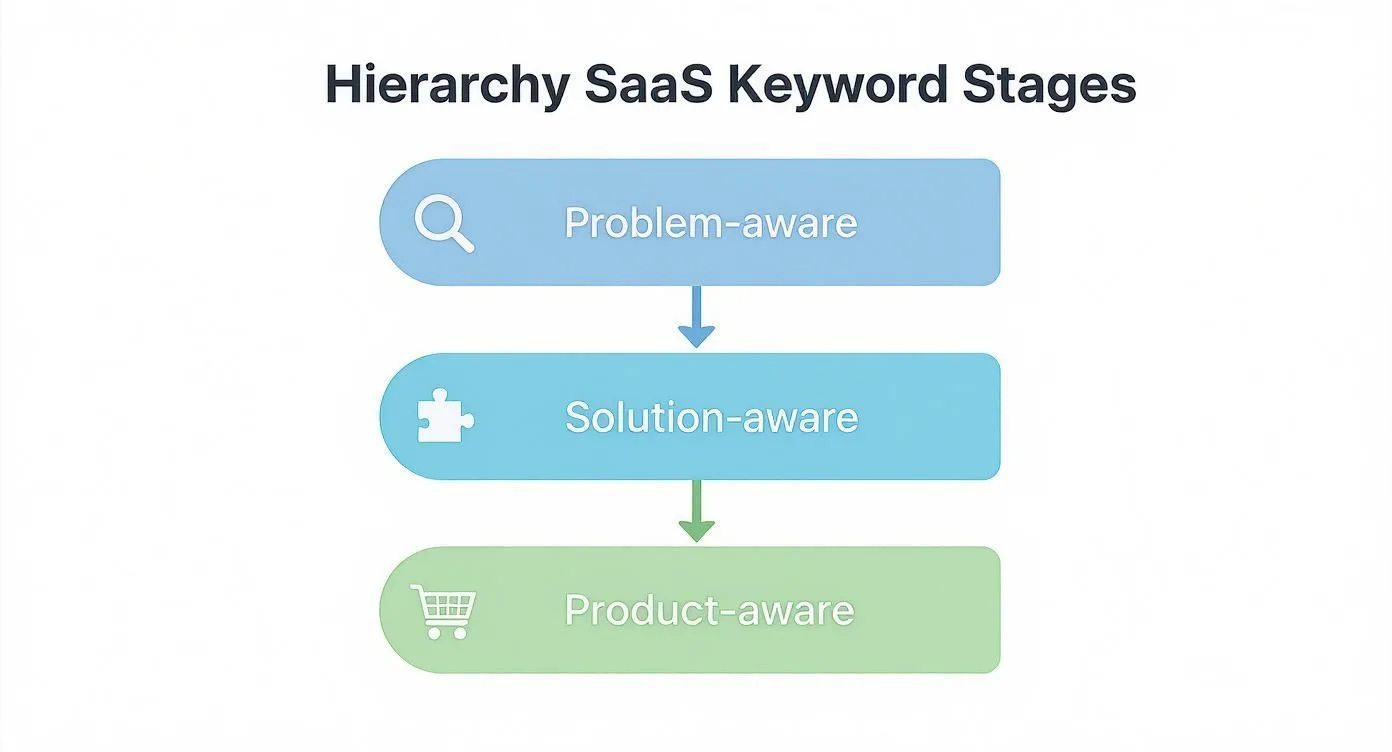
You can see how a user's search changes from broad, problem-focused terms to specific, product-focused ones. You need a different approach for each stage.
Let’s look at how to create content for each phase.
Top of Funnel: The Problem-Aware Stage
At this point, your potential customer has a problem but might not know a solution like yours exists. The goal is simple: educate them with helpful content. No hard sells.
- What to create: In-depth blog posts, free tools (like a calculator or template), and educational guides.
- Real-world example: If you sell a social media scheduling tool, an article like "How to Save 10 Hours a Week on Social Media Management" is a perfect fit.
Middle of Funnel: The Solution-Aware Stage
Now they know solutions are out there, and they're comparing options. Your content needs to show why your product is the best choice for them.
- What to create: Comparison pages ("Your Product vs. Competitor"), "best of" lists, case studies, and "alternative to" pages.
- Real-world example: A page titled "[Your Product] vs. Hootsuite: Which is Better for Small Businesses?" directly targets people in this mindset.
Bottom of Funnel: The Product-Aware Stage
This is the final step. The user is ready to buy, and your content needs to remove any last doubts and make signing up an easy choice.
- What to create: Detailed feature pages, a clear pricing page, customer stories, and specific use-case examples.
- Real-world example: A page that shows exactly how your tool helps marketing agencies improve their workflow.
Your blog is for attracting new people, but your product pages are for converting them into customers. Don't mix them up. Each piece of content should have one clear job.
On-Page SEO Essentials for Every Piece of Content
Writing great content is only half the job. If search engines can't understand it, it won't be seen. This is where on-page SEO comes in—a series of small but important adjustments you make to every page.
It's very competitive out there. The top 3 results in Google get about 22% of all clicks, while positions 8 to 10 get only 4%. With about 42% of SaaS SEO professionals saying that ranking for keywords has gotten harder since 2024, getting your on-page SEO right is a must.
Here’s your quick on-page SEO checklist:
- Title Tag: The headline in search results. Keep it under 60 characters and put your main keyword near the front.
- Meta Description: The short summary under the title. It doesn't directly affect rankings, but a good description gets more clicks. Aim for under 155 characters and include your keyword.
- URL Slug: Make your URL short and easy to read, like
yourdomain.com/blog/saas-content-strategy. - Header Tags (H1, H2, H3): Your page should have only one H1 tag for the main title. Use H2s and H3s to break your content into logical sections.
- Image Alt Text: This text describes an image for search engines. Write a clear description and include a keyword if it fits naturally.
- Internal Linking: Always link to other relevant articles and pages on your site. This helps users and search engines understand your site's structure.
By making these on-page SEO practices a habit, you give your content the best possible chance to be seen by the right people.
Link Building Strategies That Actually Work
Backlinks are a sign of authority online. When a trusted site links to yours, it tells search engines that you are a credible source. But for a startup with a lot to do, building links can feel overwhelming.
It doesn’t have to be.
The key is to focus on quality, not quantity. One great link from a major industry blog is better than a hundred links from unknown sites. The goal is to earn links that help your SEO for saas startups.
Create Genuinely Link-Worthy Assets
The easiest way to get links is to create something people want to link to. This means going beyond a standard blog post and building assets that are truly useful.
Ask yourself: what would my audience find so valuable they’d share it without thinking?
A few ideas that work well:
- Original Research or Data Studies: Survey your users or use your own data to find new industry insights. A report like "The State of Project Management in 2024," with new stats, is great for getting links from journalists and bloggers.
- Free Tools and Templates: A simple, free tool can get thousands of links. If you're a finance SaaS, a free "Startup Burn Rate Calculator" is a great asset that people will link to for years.
- The Definitive Guide: Pick a key topic in your industry and create the most complete guide about it online. If your competitors’ posts are 2,000 words, make yours 5,000 with better examples and graphics.
These assets take more work, but the payoff in links and authority is huge and grows over time.
Master the Art of Guest Posting
Guest posting is a classic strategy because it works. It puts your brand—and a valuable backlink—in front of a relevant audience you might not otherwise reach.
The secret is to be strategic. Think of it as a partnership.
Don't send generic emails to every site with a "write for us" page. Instead, find a few high-quality blogs that your ideal customers actually read.
Don’t just pitch an article; pitch a solution to a problem their audience has. Find a content gap on their site and suggest a topic that fills it. A personal, well-researched pitch is much more effective than a generic one.
When you get a guest post opportunity, write one of your best articles. Your goal isn't just to get a link. It's to impress a new audience and bring interested people back to your site.
Embrace Digital PR and Relationship Building
You don't need a huge budget for digital PR. At its core, it's just about getting your brand mentioned on other websites. A simple and powerful way to start is with relationship-based link building.
This tactic is simple and effective.
- Mention other companies: In your blog posts, link to non-competing tools or brands you like.
- Let them know: Send a quick, friendly email to the person you mentioned. It can be as simple as, "Hey, I featured your tool in my latest article. Loved what you’re building!"
- Watch what happens: This simple act often leads to them sharing your article or even linking back to it. It’s a low-pressure way to build connections and earn natural links.
All of these strategies are built on a simple idea: create value first.
Common SaaS SEO Questions Answered
Even with a good plan, SEO can be tricky. It’s a long game, and it’s easy to have questions when you’re just starting out.
Let’s clear up some of the most common questions I hear from SaaS founders.
How Long Does SEO Take to Show Results?
The honest answer is: it depends, but you need to be patient. You might see small signs of progress in a few months, but for real results that make a difference, you’re looking at 6 to 12 months.
Think of it like planting a tree. For the first few months, the important work is happening underground. You're building a strong root system with your technical SEO and early content. You won't see much growth right away, but this consistent effort sets you up for success later.
A few things can affect this timeline:
- Your starting point: A brand new website will take longer than an established one with some authority.
- Competition: Trying to rank for a very popular term like "CRM software" is hard. A more specific, niche keyword is an easier place to start.
- Your consistency: Publishing one high-quality article every week will get you results much faster than publishing randomly.
Should We Focus on Content or Link Building First?
This is a common question. My advice? Start with content. You can't build links to an empty website.
Focus your early energy on creating a small library of great content that solves problems for your target audience. Once you have around 10-15 excellent articles and your main product pages are ready, then you have something worth linking to. At that point, you can start building links.
Great content is the entry ticket for link building. You need to create linkable assets first. Otherwise, you’re asking for favors without offering anything in return.
What Is More Important: Technical SEO or Content?
They are two sides of the same coin. You need both. You could write the most amazing content, but if Google can't crawl your site due to technical problems, it won’t be seen. On the other hand, a technically perfect website with bad content is useless.
For a startup, here’s the order to follow:
- Get the technical basics right first. Fix your site structure, speed, and mobile experience.
- Then, focus on content. Once your foundation is solid, content becomes your engine for growth.
Don't get lost in advanced technical SEO at the beginning. Fix the critical issues, then put your energy into creating helpful content. You can always come back to more advanced technical tasks later.
Ready to stop guessing and get a clear, prioritized SEO plan for your startup? SEO Roast provides founder-focused SEO audits that diagnose growth gaps and give you actionable steps to grow organic traffic. See how we've helped startups like Framer and Chatbase turn search into a reliable growth channel. Learn more about our actionable SEO audits.